How to pull a kid on a tube safely comes down to four things: a properly fitted Coast Guard-approved life jacket, a tube sized for the rider, a spotter whose only job is watching the child, and a driver who stays under 10 mph with anyone under 12 on the line. Prep takes about twenty minutes. The rest is knowing what the boat is doing behind you, because most first-pull problems are not about the boat at all.
They are about a vest that rides up over a small chin, a rope that is too short, and a driver who adds throttle every time the tube swings wide. I’ve watched parents learn that lesson the expensive way. Here is the version that goes smoothly, including the recovery drill that almost every guide online skips.
One thing to sort out before you read further: if your child is under six, do not tow them. Most tubes on the market are not built for riders that small, and the speed you would need to make it fun is the speed that hurts them. A shallow-water anchored tube or a water park lazy river gives a two-year-old the same floating sensation with none of the risk.
Table of Contents
- 1What You Need
- 2Step-by-Step: How to Pull a Kid on a Tube Safely
- 31. Choose a Safe Area and Check the Weather
- 42. Inspect the Tube, Rope, and Boat
- 53. Fit the Child’s Life Jacket Correctly
- 64. Attach the Tow Rope Safely
- 75. Launch and Start at Idle Speed
- 86. Keep a Safe Distance and Assign a Spotter
- 97. Teach Basic Hand Signals and Take Breaks
- 108. Return to Shore and Shut Down Safely
- 11Common Mistakes
- 12Frequently Asked Questions
- 13What speed should you use when towing a child on a tube?
- 14What kind of life jacket should a child wear while tubing?
- 15How long should the tow rope be for a child on a tube?
- 16What should the adult do if the child falls off the tube?
- 17Is it safe to tow a tube with an adult personal watercraft?
- 18When should parents avoid towing a child on a tube?
- 19The Short Version
What You Need
Most of this list costs nothing or already lives in your garage. The point is having it on the dock, checked, before the child is anywhere near the water.
- A Coast Guard-approved life jacket in the child’s current weight band, fitted before they step out of the car.
- A child-sized towable, ideally a single-rider cockpit tube with an enclosed seat bottom so the rider sits rather than lies.
- A purpose-rated tow rope, at least 50 feet, rated for the combined weight of everyone on the line.
- A boat with a secure tow point — a ski pylon or a bolted cleat, not a handrail.
- A dedicated spotter, sober, attentive, and with clear line of sight to the tube.
- A whistle or two-way radio so hand signals have a backup.
- Water shoes, sunscreen, drinking water, and dry clothes, especially on a cold-water lake.
- Reasonable weather, checked twice.
Check the gear the same way each time, because it takes thirty seconds and it is the difference between a bad day and a bad afternoon. Look at the life jacket’s weight label and confirm it matches the weight band printed on the child’s chest today, not last summer.
Look at the tube for punctures, loose handles, fraying seams, and a valve that will not hold pressure. Run the rope through both hands looking for fuzzy, flattened or kinked sections. If any part of that gear looks tired, replace it. A tow rope is not the place to improvise with hardware store line, and it is not the place to test a repair.
Step-by-Step: How to Pull a Kid on a Tube Safely
1. Choose a Safe Area and Check the Weather
Start in open water with room to turn around without anyone hitting anything. Keep well clear of swimmers, other boats, rocks, submerged branches, docks, bridges, tree lines and slow-speed zones. If you cannot describe the water bottom within fifty yards in every direction, pick a different stretch.
Before you leave shore, check the wind, the sky and the water temperature. Leave at the first thunder, and skip the trip entirely when visibility is poor. Cold water deserves its own rule: anything near 60°F turns a fall into a serious exposure problem in minutes, not a fun splash.
You will know the area is right when the boat, the tube and the shore are all visible from the helm in one glance, and when the water below the tube is deep enough that a fall is a splash rather than a landing.
2. Inspect the Tube, Rope, and Boat
Run your hands around the entire tube before it goes in the water. Punctures near the valves leak slowly and can dump the tube’s shape mid-turn, which is exactly when the rider needs a stable platform. Loose handles are worse: a handle that lets go is the same event as a child falling off.
Check the tow rope for fraying, kinks or flattened sections, especially at the ends and near the splice. Attach the rope to the boat’s designated tow point and pull hard by hand. If the cleat moves, the weld shows, or the pylon flexes, do not launch.
The setup passes when you can put your full weight on the rope and the connection stays where you left it. That check takes fifteen seconds and it is the only one that matters most.
3. Fit the Child’s Life Jacket Correctly
Match the label to the child’s weight: infants up to 33 pounds, children 33 to 55 pounds, youth 55 to 88 pounds. Level 70 flotation suits calm inland and nearshore water; Level 100 is the offshore-rated level. Wear it before the child gets on the tube, never after.
Fasten every strap, then tighten the chest strap until it will not slip. Grasp the jacket at the shoulders and lift. If it rides up past the child’s chin or ears, it is too loose or the wrong size. Keep it snug enough that a firm tug on the collar does not move it.
An oversized vest is not a safe compromise — it can ride up over a small child’s face or let them slide out of it mid-tumble. And inflatable life jackets are not recommended for children under 16, while a pool floatie is not a flotation device at all.
4. Attach the Tow Rope Safely
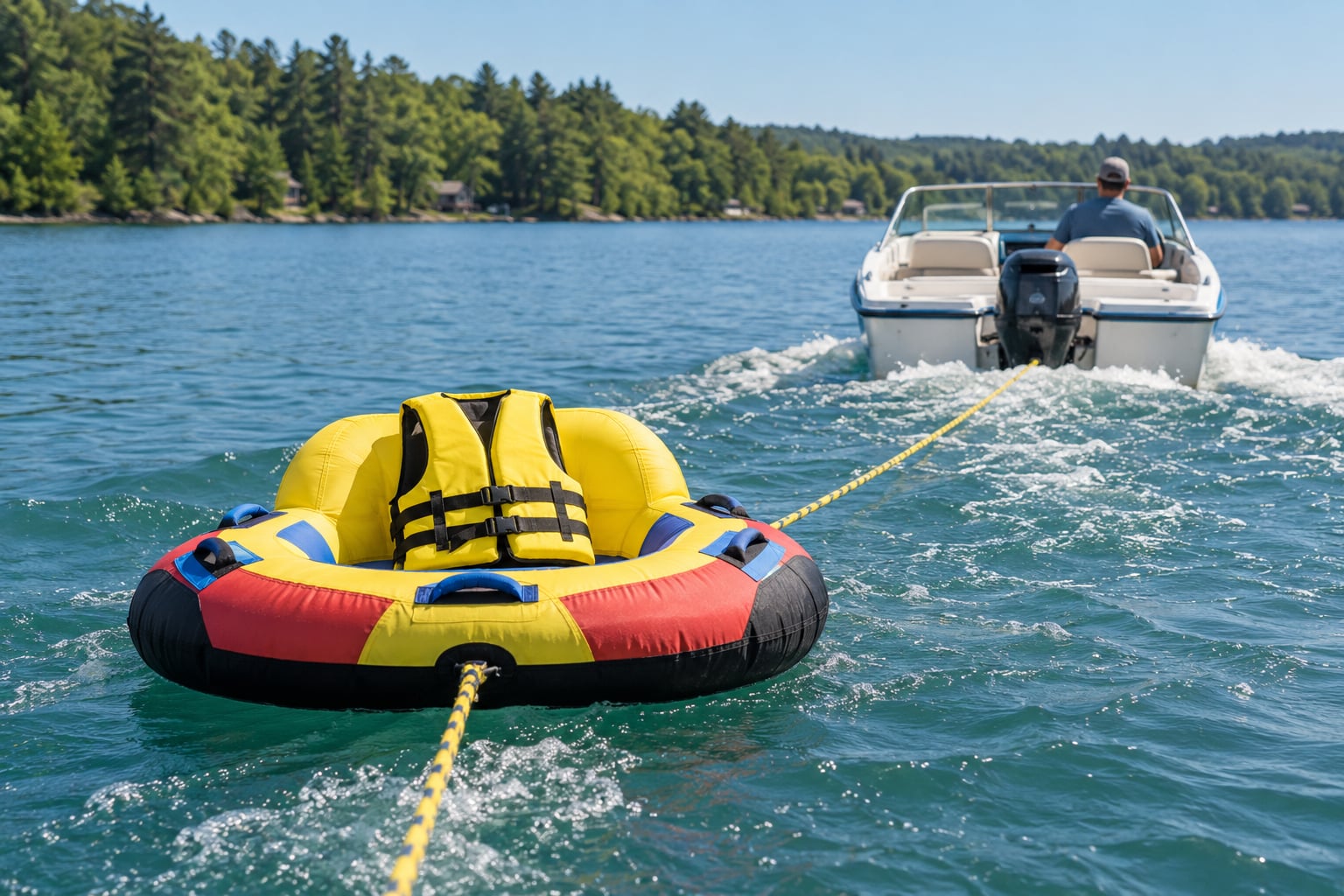
Use a rope made for towing inflatables, never a tow strap and never household line. Around 50 feet is the minimum most sources give, and longer is fine for a child because the gap between the tube and the boat absorbs the worst of a hard stop.
Clip the rope to the tube’s tow point and the boat’s tow point. Never wrap it around a handrail, a passenger or yourself — if the rope snags, the load goes somewhere a person is sitting. Coil the excess neatly on deck so it cannot run underfoot or into the propeller.
It is connected correctly when a helper can walk beside the tube without any slack catching on the gunwale, and when you can see the whole length of rope from the helm.
5. Launch and Start at Idle Speed
Set the child into the cockpit seated, knees up, feet forward and clear of the tube’s edge. Make sure they are not holding the rope and that no part of them is near the propeller. Then back the boat away from the tube slowly until the rope comes taut without a jolt.
Open the throttle to idle and hold it there until the tube lifts cleanly out of the wake. Accelerate gradually, in stages, and stop at each stage long enough for the spotter to confirm the rider is still seated and the rope is tracking straight. Only then move to the child’s speed.
With children under 12 on the tube, the number to use is under 10 mph. Some tube sellers publish 10 to 15 mph for young kids, which is why you will see both numbers online; the conservative figure from the national boating trade association is the one worth following with a child on the line.
6. Keep a Safe Distance and Assign a Spotter
The spotter’s only job is the rider. Not the phone, not the music, not the conversation. They should be facing aft with a clear view, able to see the tube from the driver’s position without standing up, and able to be heard over the engine.
Drive long sweeping arcs rather than sharp turns. Gentle S-shaped turns help a tube drift out of the boat’s own wake instead of getting caught in it, which is the single biggest cause of riders being flung off. Slow down crossing any wake, and stay a good distance from the propeller, other boats, docks and anything floating.
You are in control when the spotter can answer three questions at any moment without looking away: is the rider on the tube, is the rope straight, and is the tube still on the correct side of the wake?
7. Teach Basic Hand Signals and Take Breaks
Agree the signals before the first pull, while everyone is still calm. Thumbs up means faster, thumbs down means slower, a flat hand across the neck means stop immediately, and a wave toward the boat with an open palm means come back to shore. Rehearse them once on the dock.
Young children cannot be relied on to signal reliably. That is precisely why the driver stays at a speed the rider can survive if every signal is missed, and why the spotter watches hands rather than listening for words.
Plan a break every fifteen or twenty minutes, or sooner if it is cool out. Check for chafing at the hips and under the arms, cold hands, sunburn, and any sign of the rider sliding or losing balance. A child who looks tired is telling you something.
8. Return to Shore and Shut Down Safely
Signal the rider to close it down, then come off the throttle well before you reach the tube. Approach slowly and from the side away from the propeller. Do not let the child swim to the boat, and do not hand them the rope while the engine is running.
Put the engine in neutral, shut it off, and only then unhook the rope. Help the child out of the tube and onto the boat before anyone climbs back aboard. Let the tube float free or drag it alongside rather than leaving it loose in the water for the next boat to run over.
The tow is over when the engine is off, the child is inside the boat wearing a dry or cooling life jacket, and the tube is secured. That is the point at which you can finally look up.
Common Mistakes
Almost every tubing accident traces back to one of these, and almost all of them are fixable in the ten minutes before you start.
- A rope that is too short. It slams the rider toward the boat at speed. Use 50 feet or more for a child.
- Towing too fast for the smallest rider. Speed belongs to the least capable person on the water, not the most excited one.
- No spotter. Without a dedicated watcher, a fall happens silently.
- Putting the life jacket on after launch. Fit it on the dock, where you can check the lift test.
- Two children on one tube, or children between tubes. One rider per tube, always.
- Abrupt turns and throttle changes. Sharp steering is what throws riders, not speed by itself.
- Using a tube with a worn handle or a soft valve. Replace it; do not patch it.
- Not checking for swimmers and traffic first. Stay roughly 50 yards from other boaters and know where the swimmers are.
- Staying out as weather turns. When the sky or the wind changes, end it early.
The underlying rule across all nine: pick easier conditions than you think you need, and stop the moment anyone on the boat feels uneasy. An afternoon cut short is a good afternoon.
Frequently Asked Questions
What speed should you use when towing a child on a tube?
Stay under 10 mph whenever a rider is under 12 years old. You will see higher figures online, including 10 to 15 mph for young children from some tube retailers, but the conservative guidance from the national boating trade association is the number to follow with a child on the line. Speed should also stay under whatever the tube manufacturer lists as its maximum towing speed, and drop further in cold water, rough conditions or heavy boat traffic.
What kind of life jacket should a child wear while tubing?
A Coast Guard-approved life jacket in the child’s current weight band, worn before they get on the tube. USCG labels are weight-based: infants up to 33 pounds, children 33 to 55 pounds, and youth 55 to 88 pounds. Fasten every strap, tighten the chest strap, then lift the jacket at the shoulders to confirm it will not ride above the chin or ears. Inflatable life jackets are not recommended for children under 16.
How long should the tow rope be for a child on a tube?
At least 50 feet. Longer is safer for a small child because the extra distance softens the jolt when the boat accelerates, stops or turns, and it keeps the tube well clear of the propeller. Use rope specifically made for towing inflatables rather than a tow strap or household line, and never wrap it around a handrail or a passenger. Inspect for fraying and replace it rather than repairing it.
What should the adult do if the child falls off the tube?
Stay calm and do not circle back at speed. Hit the kill switch if the boat is moving fast, put the engine in neutral, and keep your eyes on the child continuously so they never leave your sight. Approach slowly from the downwind side so your wake does not push them further from the boat, reach the child slowly, and get them aboard before restarting the engine. The spotter should be pointing at the child continuously during the whole recovery.
Is it safe to tow a tube with an adult personal watercraft?
It can be, with limits. Many personal watercraft are not rated to tow, and rules vary widely by state and country. Canada, for example, requires a designated spotter, one empty seat per towed rider, and a personal watercraft rated for at least three people, with towing barred in poor visibility and from sunset to sunrise. Check your local boating rules and the watercraft owner’s manual before towing with a PWC at all.
When should parents avoid towing a child on a tube?
Do not tow a child under six, since most tubes are not built for riders that small. Skip towing entirely during thunderstorms, poor visibility, heavy boat traffic, near shore or over shallow water with submerged debris, and in cold water where a fall becomes a hypothermia risk. Also skip it if the child is not a comfortable, attentive rider, if the tube’s handles are worn, or if the only adult available is going to be drinking.
The Short Version
Start on the dock, not at the ramp. Weigh the child, read the weight band on the vest, check the rope for fuzz and the tube for loose handles, and decide who is driving and who is watching before anyone is wet.
Then run it slow. Idle, then a gentle stage, then a second stage only if the spotter says everything is straight. Under 10 mph for anyone under 12, one rider per tube, a dedicated spotter, and an engine that goes off before the rope comes off. That is how to pull a kid on a tube safely, and it holds even on the days when the lake is not cooperating.