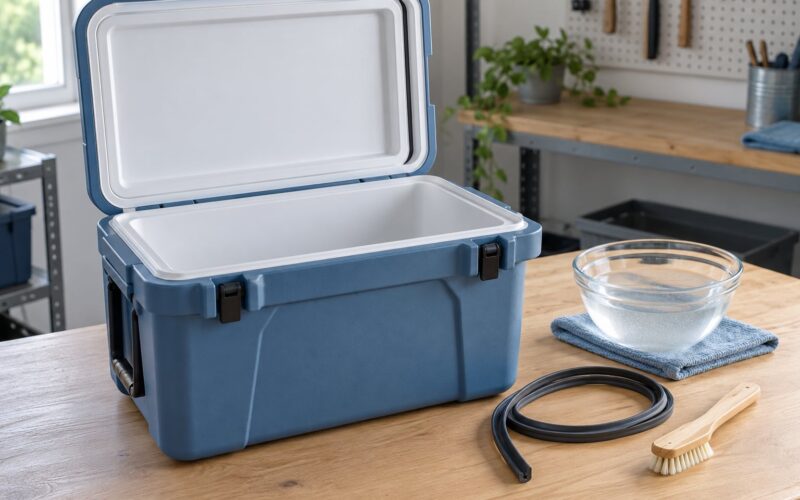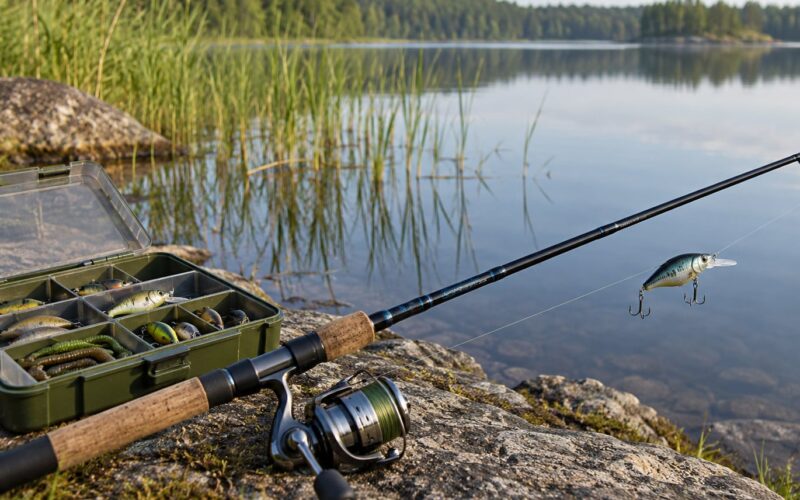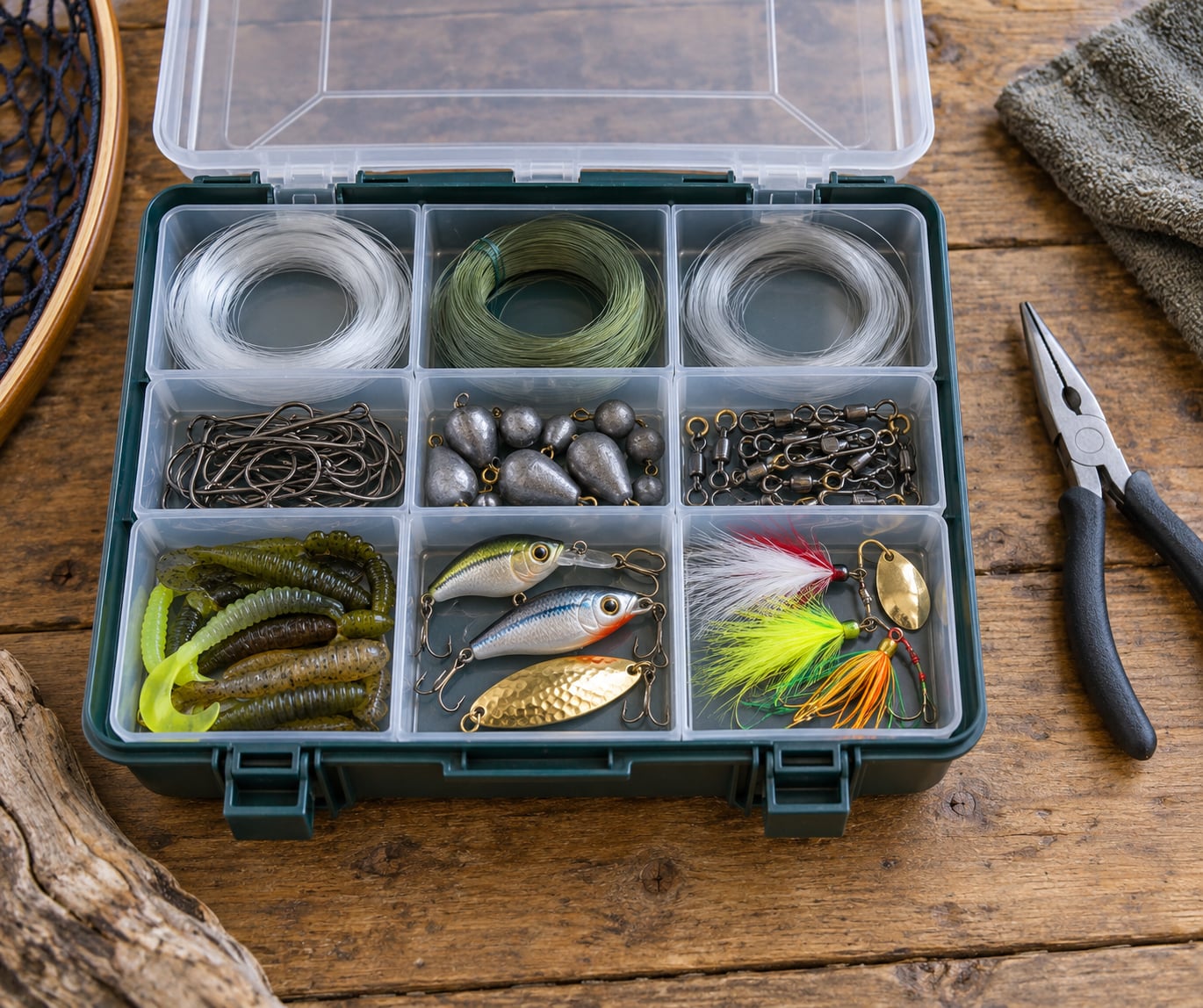
The fastest way to know how to organize a tackle box is to treat it as a map rather than a storage pile: empty it, sort every piece into one of six groups, give each group a dedicated compartment, secure the small metal parts, keep soft plastics flat, and label the outside. Do that once and a full box of tackle takes about an hour to sort, then ten minutes after every trip to stay that way.
The whole thing works on a worktable, a kitchen table, or the tailgate of a truck. Most of what you need is already in the box.
Table of Contents
- 1What You Need
- 2How to Organize a Tackle Box Step by Step
- 31. Empty and Categorize Everything
- 42. Choose a Storage System
- 53. Sort Hooks and Terminal Tackle
- 64. Separate Lures by Type and Use
- 75. Store Line, Tools and Small Accessories
- 86. Label and Create an Easy Retrieval Order
- 9Common Mistakes and How to Fix Each One
- 10How to Keep Your Tackle Box Organized
- 11Frequently Asked Questions
- 12What is the best way to organize a tackle box?
- 13How many tackle boxes should an angler own?
- 14Should hooks be stored in a tackle box?
- 15How do I keep soft plastics from melting or sticking together?
- 16Where should fishing line and extra line be stored?
- 17Conclusion
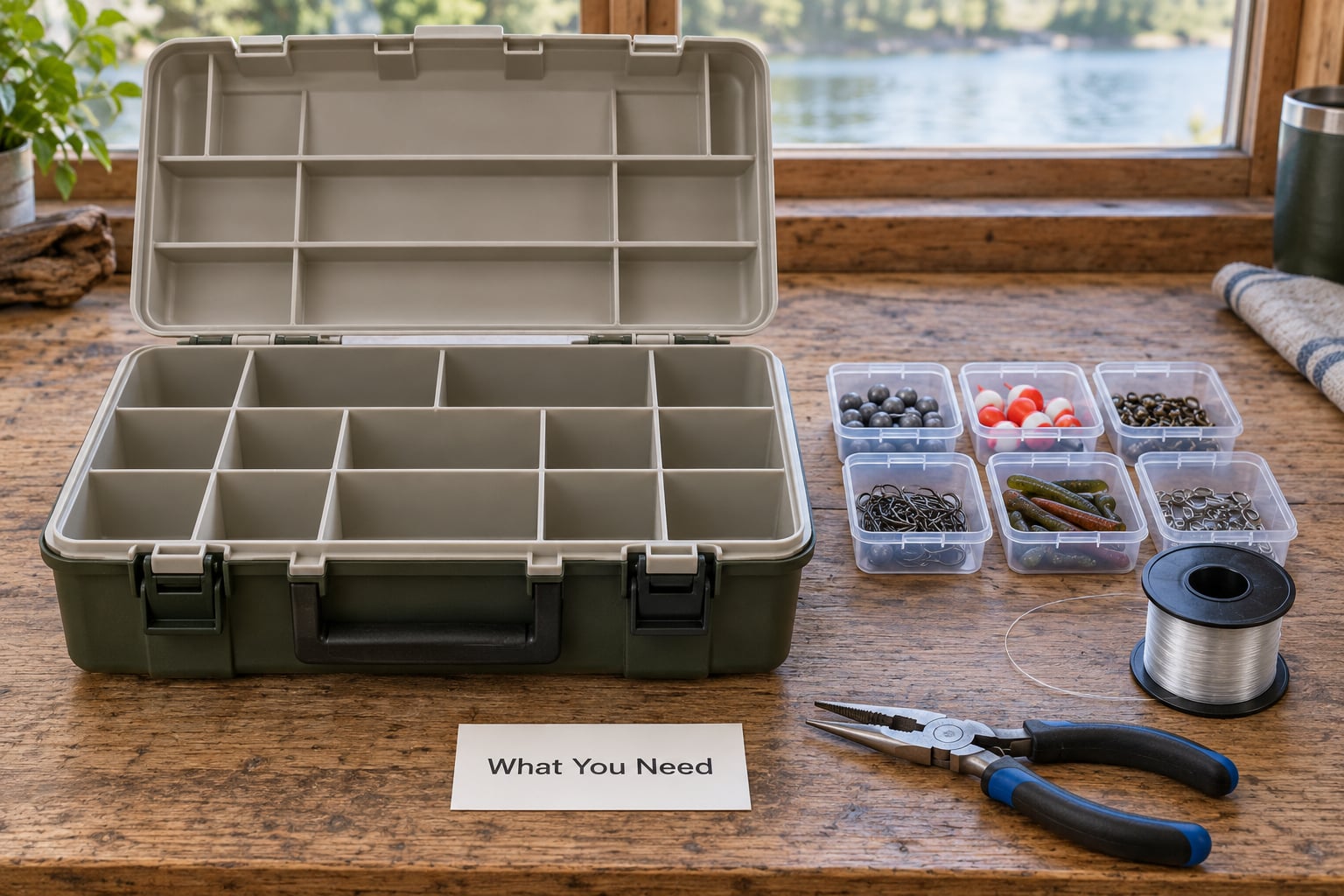
What You Need
None of this is mandatory, and none of it is expensive. It is the small set of things that turn a sorting job into a system that holds up.
- A tackle box with movable dividers. If your box has one fixed cavity, adjustable dividers or a couple of small clear bins inside it will do the same job.
- Small clear bins or utility trays. These are the building block most anglers use, because you can lift one tray out and carry only that tray to the water.
- A hook-closing tool or strip. It closes the eye of a hook so the point cannot catch a soft plastic, a shirt sleeve, or another hook.
- A label maker, colored tape, or a fine marker. Any of the three works. What matters is that the label lives on the outside of the container.
- Fishing line, spare hooks, and a spare leader material stash. Having a little of each in the box saves a trip to the truck at the worst moment.
- A simple inventory sheet. A phone note listing what belongs in each box is enough. A paper list works too.
How to Organize a Tackle Box Step by Step
Six steps, in this order. The order matters, because labeling a box before you know what goes in it means labeling it twice.
- Empty and clean the box.
- Group gear into six categories.
- Use dividers or trays to split the compartments.
- Store hooks and terminal tackle securely.
- Keep soft plastics flat and separated.
- Label the outside of every container.
1. Empty and Categorize Everything
Spread the entire contents of the box across a clean surface before anything goes back in. This is the step people skip, and it is the one that makes the rest possible.
As you spread it out, discard anything broken: rusty hooks with a dull or blunted point, soft plastics with a torn tail or a stiffened body, frayed line, and cracked or cloudy plastic boxes. Anglers accumulate far more lure than they use, and a box that no longer fits its contents is a packing problem, not an organization problem.
Then group what remains into six piles:
- Hooks and terminal tackle — hooks, swivels, snaps, sinkers, sinker slides, split rings, beads and sleeves.
- Soft plastics — worms, craws, swimbaits, creature baits, and anything else rubber or silicone.
- Hard baits — crankbaits, jerkbaits, spoons, jigs, spinner lures, and topwater plugs.
- Rods and reels — not in the box, but decide now what travels with it.
- Line and leader material — spools, fluorocarbon, and pre-tied leaders.
- Tools and safety supplies — pliers, line cutters, a disgorger, floats, a whistle, a first aid item, and a spare carabiner.
You know the sort worked when every single piece in front of you belongs to exactly one pile and nothing needs a second look.
2. Choose a Storage System
There are three workable approaches, and the right one depends on how much tackle you carry and how far you walk.
A single box with dividers suits one angler with modest gear who fishes from a boat or a fixed bank. Everything is in one place, nothing gets lost between containers, and there is one lid to close.
A multi-tier box with a deep lower section and shallow upper trays works well when you want hook and terminal tackle separated from lures by height, so digging for a soft plastic never means sorting through metal.
Removable trays inside a soft-sided tackle bag is the setup most experienced anglers describe. One long-lived thread on an angler forum makes the core point: anglers commonly carry small plastic utility boxes and swap trays in and out depending on the outing, and many build a tray on demand rather than pre-building a full system. A related thread recommends pocket-sized divider boxes per outing instead of one large box, since one box per species becomes unwieldy as the species list grows.
Pick by volume and portability. More boxes mean faster access and less digging, but more to carry and more to keep track of. Fewer boxes mean a lighter load and slower retrieval. Either is fine, as long as the choice is deliberate.
3. Sort Hooks and Terminal Tackle
Terminal tackle is the group that causes the most damage, because it is all small metal with sharp or pointy edges. Group it by type and size, and never let it share a loose compartment with anything else.
- Hooks by size and style, kept in their original packaging or on a hook strip.
- Swivels and snaps in one compartment, split by size.
- Sinkers, slides and split rings in a separate compartment, sized apart so a sinker cannot sit on a bead.
- Leaders in their own pocket so they do not knot up with loose line.
Two habits prevent most tangles. First, close the eye of any hook you are storing loose with a hook-closing tool or a strip, so the point cannot hook into a soft plastic or a finger. Second, keep sinkers below or beside hooks rather than in the same pile, because weight and pointy metal in one compartment is exactly the combination that ends up knotted.
You know this step worked when you can tip the tray upside down over your knee and nothing falls out or catches.
4. Separate Lures by Type and Use
Hard baits and soft plastics fail in opposite ways, so they never share space.
For hard baits, sort by how you will use them rather than by color alone: shallow runners, deep crankbaits, spoons, spinner lures and topwater each get their own section. Anglers commonly store spinner lures and beetle spins on cork sheets, EVA foam, or plastic trays held with rubber bands or straps, which keeps the treble hooks from walking into each other. For crankbaits, let each one sit in its own slot or lip against a divider so a rattling treble cannot chip a neighboring bait’s paint. A storage grid that leaves a finger-width of space around each lure does more for your collection than any closed compartment.
For soft plastics, the fix is simple and often skipped: keep them in their original packaging and lay them flat. Soft plastics pick up chemicals from fresh PVC plastic and get chemically degraded, bent tails, and stuck together. Minnows and swimbaits that ship in many individual bags do best in a soft-sided worm bag, where they sit flat with a bit of air between them. Keep a dedicated compartment where nothing sharp lives above them.
5. Store Line, Tools and Small Accessories
Small, frequently used items need dedicated secure spots, because those are the things a hand reaches for while the rod is under tension.
Wind line onto a bobbin or a small spool rather than a loose coil in the bottom of the box; a loose coil tangles with everything else the first time the box tips. Line cutters and pliers get an elastic loop or a dedicated pocket so they cannot chew through soft plastics. Floats and strike indicators live in their own section, not mixed with swivels. Add a small clip-on carabiner for keys, and keep a whistle and a small first aid item in the same corner every time so you do not go looking for them.
6. Label and Create an Easy Retrieval Order
Label the main categories, and put the labels on the outside of the container. A label inside a closed box tells you nothing at the moment you need it.
A simple color convention works better than an elaborate one. Many anglers pick one scheme and keep it: color by lure type, color by species, or color by depth range on the water. Pick the one that matches the way you actually fish, write the category on the lid, and be consistent. Colored tape is cheap and replaceable; a label maker gives you cleaner text and is worth it once you own more than one box.
Then arrange for retrieval order, not for storage logic. Put the tackle you use most in the compartments that open first and sit on top. A depth chart on the inside of the lid, or a phone photo of your packed box, is a good memory aid on unfamiliar water.
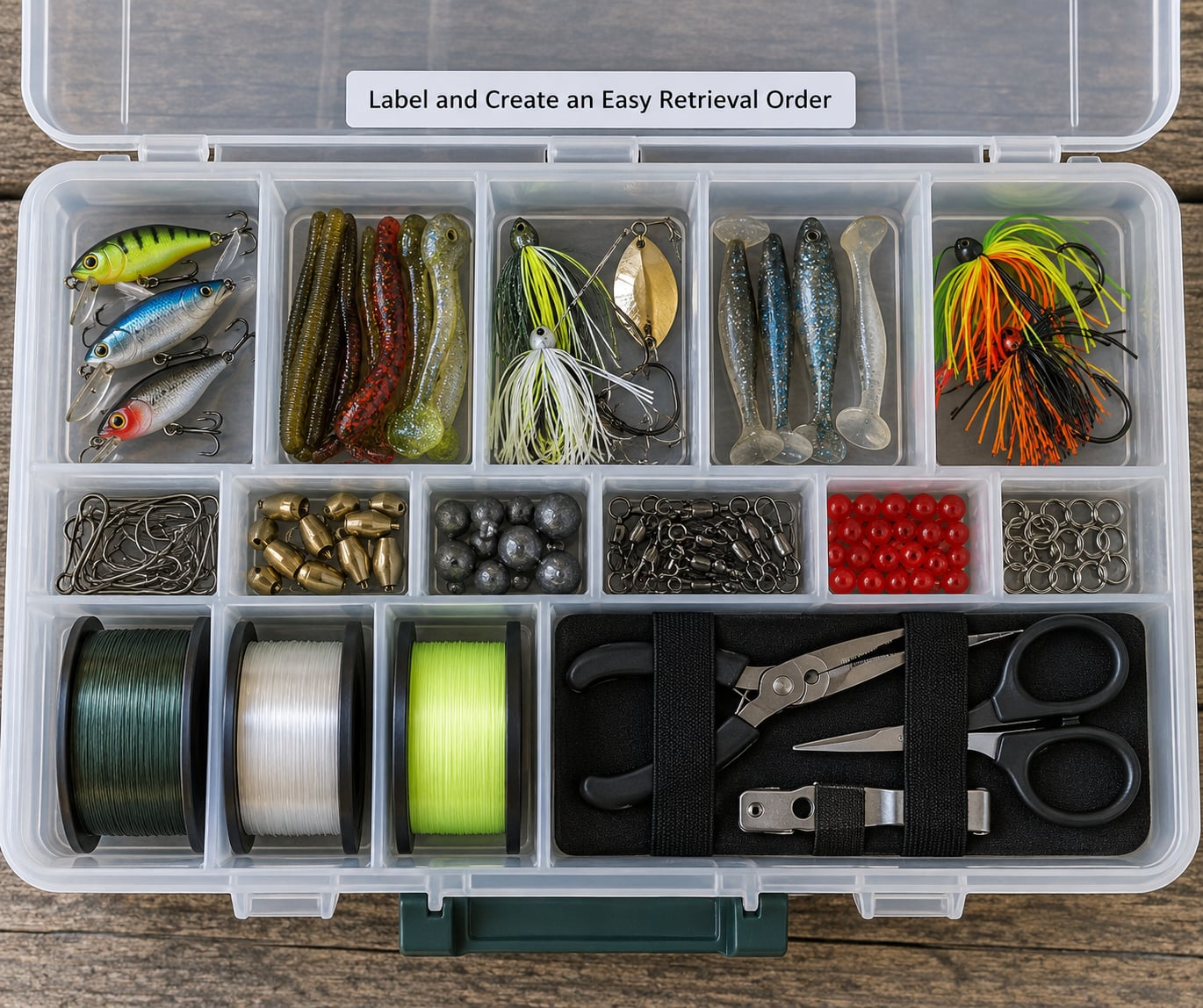
Finally, write your inventory list. A simple list of what belongs in each box catches the two problems that hide in a closed lid: something that migrated to another box, and something that broke or ran out. Update the list each time you change the system.
Common Mistakes and How to Fix Each One
Overcrowding. A box packed to the lid is a box where nothing is visible. Take half the tackle out, keep the half you actually use, and store the rest at home or in a vehicle box.
Over-labeling. Tiny labels for every single hook size are noise. Label the main categories only, and let the dividers do the finer work.
Poor weight distribution. A box loaded with sinkers in one tray and nothing in the other tips and spills. Distribute weight across the whole tray, with the heaviest items low and centered.
Loose hooks. Open points snag everything. Close the eyes, keep hooks in packaging or on strips, and keep hooks out of the compartment with soft plastics.
Tangled line. Loosely coiled line in a shared compartment is the single most avoidable mess. Wind it onto a spool or bobbin and give it a pocket of its own.
Disorganized backups. The spare hooks, spare line, and backup lures are the items that get thrown in at the bottom and forgotten until the trip is half over. Give backups their own labeled tray so you know they are there.
Ignoring moisture. Anglers regularly report rust on hooks and sinkers in humid or saltwater conditions. Airtight lids, a couple of moisture-absorbing rust prevention strips in each box, and opening the boxes to air after a wet or humid trip keep corrosion down.
How to Keep Your Tackle Box Organized
One honest ten-minute reset after every trip does more than an afternoon of sorting once a month.
Reset at the end of the trip. Empty each tray on the tailgate, rinse off salt and mud, dry hooks and sinkers, and put everything back in its labeled group. If a piece did not survive the trip, discard it now rather than rediscovering it in three weeks.
Check for damage on the way home. Look for dull hook points, bent hooks, torn soft plastics, and rust on any metal that spent the day wet.
Update labels when the system changes. The moment you add a tray, retire a lure, or split a category, relabel. Stale labels are worse than no labels.
Pack by conditions, not by habit. A short list beats a full box in most situations:
- Hot and still water: topwater, a frog or creature bait, a few soft plastics, and one deep crankbait. Leave the heavy sinkers at home.
- Cool or moving water: a spinnerbait or jig, a shallow crankbait, a curly-tail grub, and one or two sinking baits.
- Rainy or cold trips: an extra layer of terminal tackle, spare hooks, a warmer layer of line in your pocket, and the tools that keep you out of trouble.
- Multi-species outings: a small pocket box per species rather than one large box, so a crappie rig and a bass rig never end up in the same compartment.
Rotate seasonally. Once a year, pull the tackle you did not touch since last season into a vehicle storage bin. What remains is the collection that deserves the good box.
Frequently Asked Questions
What is the best way to organize a tackle box?
Sort by function first, then by frequency of use. Empty the box, group tackle into hooks and terminal tackle, soft plastics, hard baits, line and tools, split the compartments with dividers or small trays, then arrange everything so the gear you use most sits on top and in the first compartment you open.
How many tackle boxes should an angler own?
One well-organized box handles modest gear for a single species. Add a second once you fish two very different targets, since bass and panfish rigs need completely different terminal tackle. Beyond that, small pocket-sized boxes per outing keep each trip light and stop lures from one species mixing with another.
Should hooks be stored in a tackle box?
Yes, but never loose. Keep them in their original packaging, on a hook strip, or in a compartment of their own with the eyes closed by a hook-closing tool. Open points snag soft plastics, line, and fingers, and a pile of bare hooks in a shared compartment tangles the first time the box tips over.
How do I keep soft plastics from melting or sticking together?
Store them flat in their original packaging, spaced so they do not touch, in a compartment with nothing sharp above them. Soft plastics react chemically to fresh PVC plastic and can deform, so a soft-sided worm bag is a better home for swimbaits and minnows than a hard plastic tray. Replace any bait that feels stiff or tacky.
Where should fishing line and extra line be stored?
Wind it onto a bobbin or small spool and give it a dedicated pocket or elastic loop, never a loose coil at the bottom of the box. Keep the spool away from hooks and sinkers, and carry one small spare of the line you actually fish with rather than a large spool of something else.
Conclusion
Start by emptying the box onto a clean surface and sorting everything into six groups: hooks and terminal tackle, soft plastics, hard baits, line and leader material, tools, and safety supplies. Discard what is broken, give each group a real compartment, secure the small metal parts, and label the outside.
That is the whole priority: keep the tackle you use most visible, protected, and one lid-open away, so the only thing a cluttered box costs you is the fish you would have caught on the next cast.