Most anglers who keep catching small fish are solving the wrong problem. If you want to know how to catch bigger fish instead of small ones, stop adding bait and casting faster. What actually moves you up the size curve is changing three things: the size of the bait, the depth and location you fish, and how strong your tackle is when a fish does commit.
Big fish eat big prey, hold on edges and drop-offs rather than open flats, feed hardest in low light, and break light gear without much effort. Fix those four things and the same lake produces a completely different result.
Table of Contents
- 1Why Am I Only Catching Small Fish?
- 2What You Need
- 3How to Catch Bigger Fish Instead of Small Ones: Step-by-Step
- 4Start by Finding Where Larger Fish Feed
- 5Choose a Bait or Lure That Fits the Feed
- 6Fish at the Right Time and Depth
- 7Make a Slow, Natural Presentation
- 8Use Scent, Contrast, and the Right Hook
- 9If You Keep Catching Small Fish, Change One Variable
- 10How to Catch Bigger Fish Instead of Small Ones: Set the Hook and Play the Fish
- 11Common Mistakes
- 12Fishing Over Shallow Schools
- 13Using Overly Large Bait in Deep Water
- 14Retrieving Too Quickly
- 15Changing Everything at Once
- 16Ignoring Water Temperature
- 17Applying Too Much Hook-Set Pressure
- 18Frayed Leader or No Bite Tippet
- 19Spooking the Water You Want to Fish
- 20Frequently Asked Questions
- 21Why am I only catching small fish?
- 22Should I use bigger bait to catch larger fish?
- 23Is it better to fish early morning or late evening?
- 24How do I find bigger fish in a lake?
- 25Should I move if I am catching small fish?
- 26What color lure catches bigger fish?
- 27Conclusion
Why Am I Only Catching Small Fish?
You catch small fish because your presentation selects for whatever is most abundant and most aggressive in the lake. A small lure fished shallow in open water is an easy meal for panfish and juvenile bass, so those fish take it first. Bigger fish are fewer, live deeper or along structure edges, and will usually ignore a meal they have to fight a smaller fish for. Nearly always, upsize the bait and drop a foot or two deeper before buying anything new.
What You Need
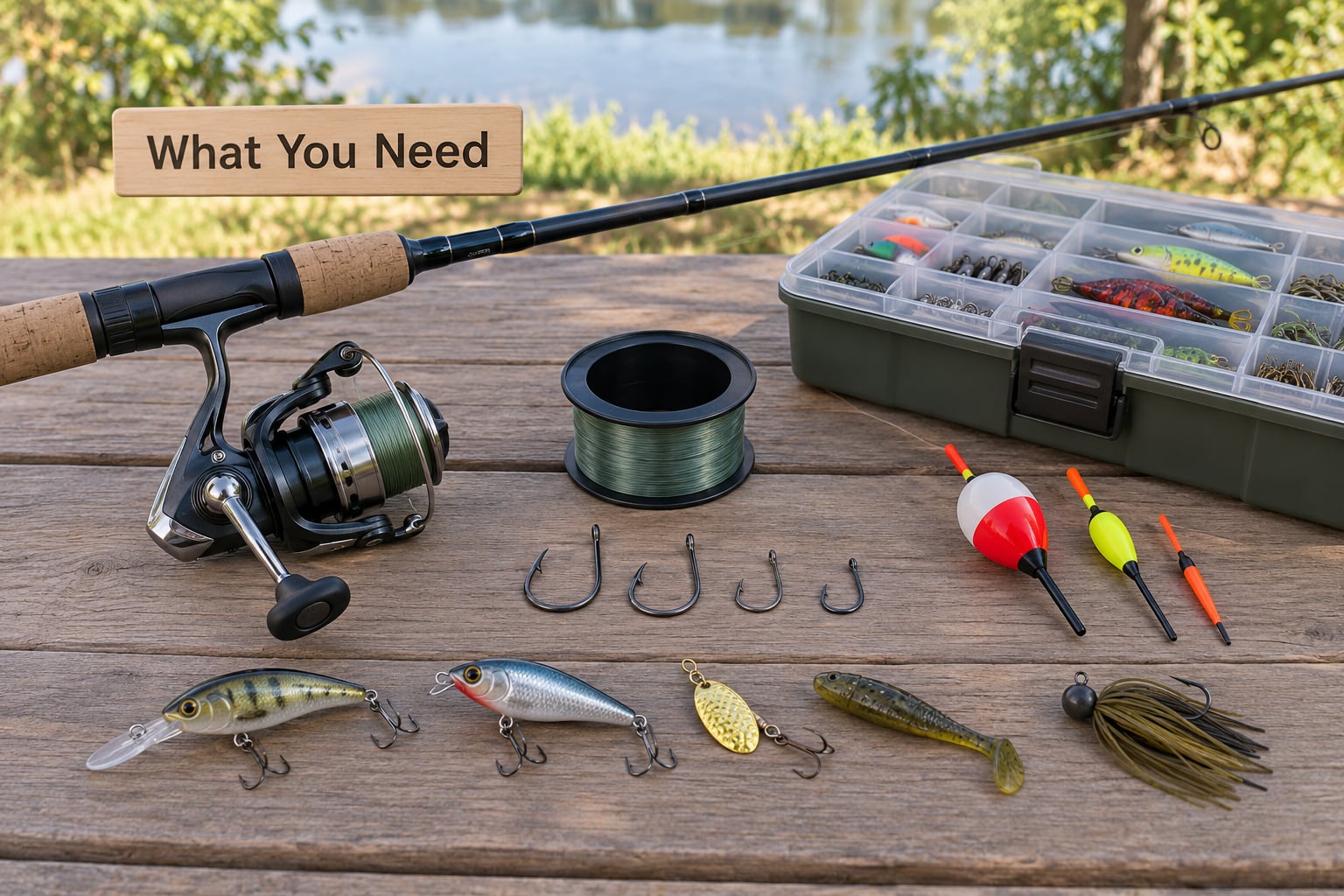
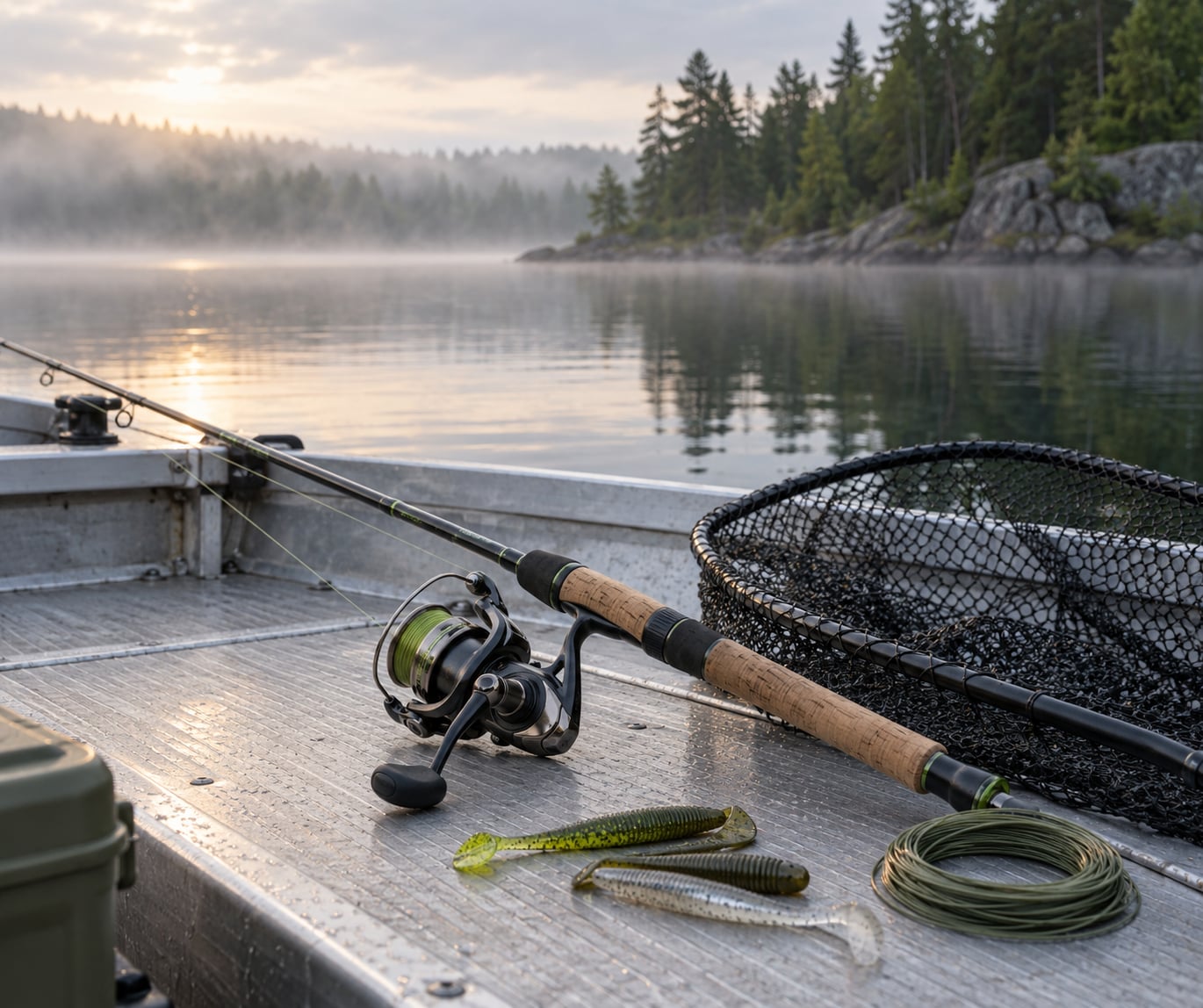
Gear matters here, but only two items usually need replacing: your line and your leader. Everything else you can adjust with what you already own.
- A rod with a stiff enough tip. You need enough backbone to pull a fish off structure, not enough to snap the tippet when it turns. Medium-heavy to heavy power covers most lake scenarios for larger fish.
- Line matched to the target, not to the panfish. If you are chasing fish in the three to ten pound range, spinning tackle at 20 to 30 lb test or a heavier braid is a sensible starting point.
- A leader and a bite tippet. A fluorocarbon leader resists abrasion from rocks, shells and vegetation. Add a 10 to 20 lb bite tippet in clear water where big fish are line-shy.
- Terminal tackle in the right weight class. Jig heads heavy enough to reach the depth without a lot of rod lift, hooks sized to the bait, and swivels rated above the strain.
- A range of bait sizes. Bring at least one lure well above panfish size, plus a mid-size soft plastic and a deep crankbait or jig.
- Fish-finding tools. A depth finder or a sounder for structure and depth changes, and a simple thermometer. Note that local rules often restrict sonar and electronic devices, so check before you launch.
- Weather awareness. Wind direction, a falling barometer, and water temperature tell you more about where fish will be than the calendar does.
- Local regulations. Bag and size limits, protected species, gear restrictions, and season dates change often. Read the current rules for your water before you fish it.
This table is the short version. Match the setup to the size of fish you expect, not the fish you are currently catching.
| Target fish size | Line test | Rod power | Leader / tippet | Typical drag |
|---|---|---|---|---|
| Panfish to 2 lb | 6 to 10 lb braid or fluoro | Medium | 10 to 15 lb fluoro | Loose, roughly one third of the line strength |
| 3 to 6 lb | 15 to 20 lb braid | Medium-heavy | 15 to 25 lb fluoro | Set with a scale, roughly half of line strength |
| 6 to 12 lb | 25 to 40 lb braid | Heavy | 25 to 40 lb fluoro | One third to one half of line strength |
| Punching thick cover | 40 lb braid or heavier | Heavy | 40 lb fluoro | Heavy but below the braid rating |
How to Catch Bigger Fish Instead of Small Ones: Step-by-Step
These seven steps run in the order that produces the biggest change per hour spent. Work through them in sequence rather than jumping around, and you will know exactly which lever failed when the fish you want do not show up.
Start by Finding Where Larger Fish Feed
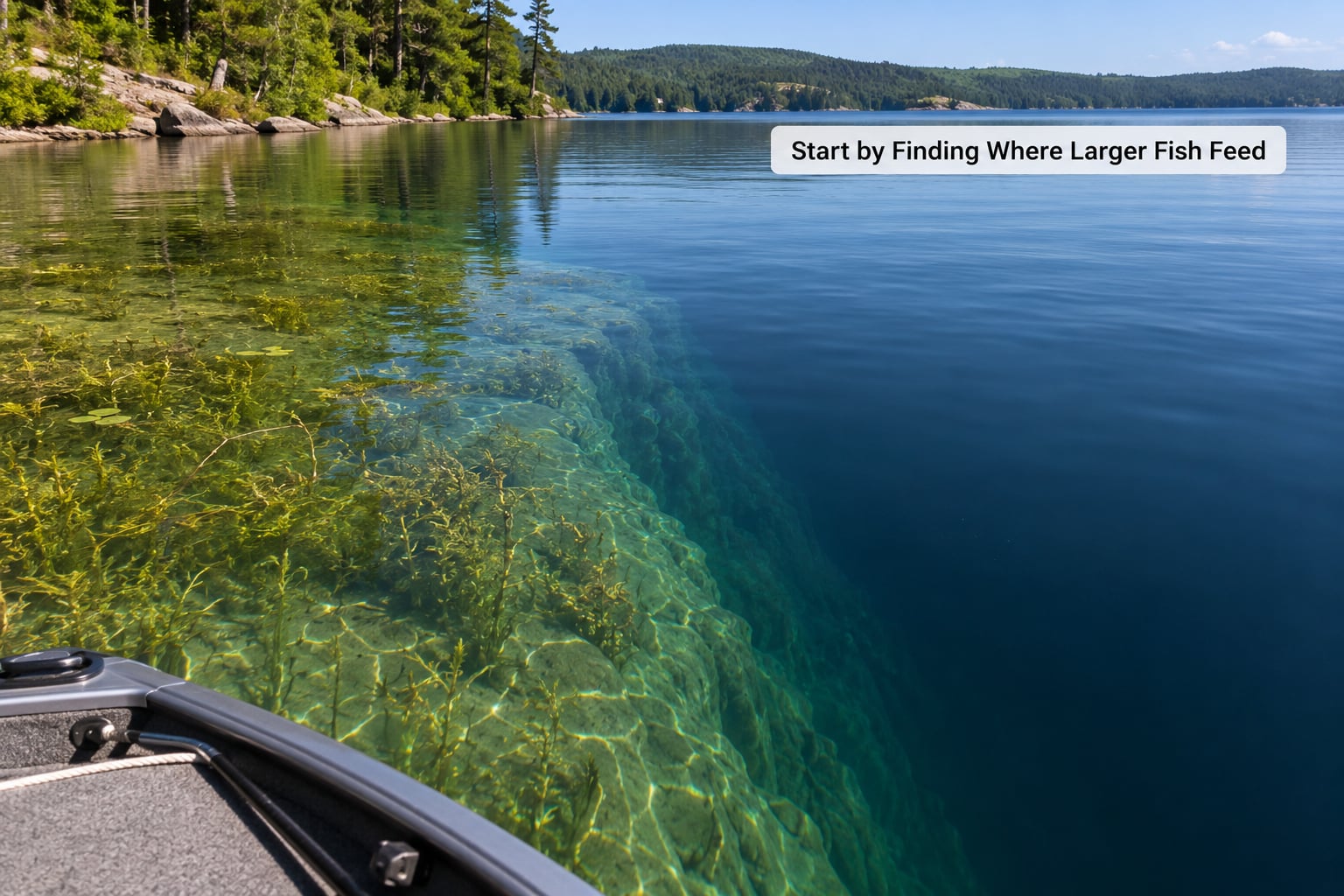
Larger fish hold where small fish do not: the edge of a feature, not the feature’s centre. Look for the margin where a weed bed or rock ledge drops into open water, the shoulder of a submerged point, a channel between two basins, and the transition from a shallow flat into deeper water nearby.
Drop-offs are the single most reliable structure on most lakes. The steep face gives large fish a place to sit with a current or temperature break in front of them, and it puts deep water within casting range of shallow cover.
Current seams matter in rivers and inflow areas. Where fast water meets slow water, food collects, and the largest fish sit in the seam facing upstream with an easy exit behind them.
Watch for evidence rather than guessing. Repeated boils on the surface, a circling gull flock, a bait ball pushed against a bank, or an oil-slick-free disturbance near a specific rock all tell you fish are using that water. Foggy mornings reward listening as much as looking: a distinct popping noise usually means something large is feeding on a shallow flat.
You will not find big fish everywhere. Some lakes in a given week simply do not hold much beyond panfish and small juveniles, and that is a fact about the lake, not about your technique. Do the diagnostic work honestly, then move on instead of grinding water that has nothing in it.
Choose a Bait or Lure That Fits the Feed
Bigger baits catch bigger fish because bait size is a filter. A lure that a small fish can comfortably swallow is a lure a small fish will take. Anglers who want to skip panfish usually start by using lures that sit outside the range those fish can commit to, which is why the advice to “use bigger bait” keeps showing up in fishing forums and magazine columns.
The rule is simple: big baits equal big fish. A 5 inch swimbait with a 1/2 ounce jig head will catch trout that a 2 inch marlin will never reach, and the same is true in reverse for panfish.
Match the size to the lake’s actual prey base rather than to a chart. If you keep catching fish, open the stomach of one and see what is inside. A shiner, a crayfish, a small trout or a beetle tells you the size class and colour that the lake is eating, and you can pick a lure that matches it.
A practical spread for most lakes: a large swimbait and a 5 to 6 inch soft plastic for shallow cover, a 3 to 4 inch creature bait on a 1/8 to 1/4 ounce head for the mid-depth drop-off face, and a deep crankbait or 1 to 2 ounce jig for vertical fishing in 20 feet or more.
Depth matters more than most beginners assume. A jig head sized for eight feet of water will not reach a ledge in 18 feet, and a lure you drag on the bottom in the wrong depth simply never gets offered to a fish holding below it.
Trolling large baits is the other half of the big-bait approach and it works well in open water. Run deep-diving cranks over the same drop-off you would cast to, with the rod in the holder pointed at the line so you can feel a strike instead of missing it.
Fish at the Right Time and Depth
Bigger fish feed hardest in low light and during temperature transitions, and they move to a specific depth band you can find rather than guess. Work these windows in order: dawn and the first hour after sunrise, the last hour before sunset into twilight, and any overcast morning where the light stays flat all day.
Water temperature drives depth more than anything else. During the cold part of the year, bigger fish hold deep and slow near the bottom. Through the spawn and the summer heat, they push into the shallows and hold tight to structure. Between those two extremes, they sit on the shoulder of the drop-off, at the depth where the temperature stabilises fastest.
Watch surface signs in the shallows when you fish the spawn window. Turbulence, a bulge on the surface, or a bed disturbed just under a buoy tells you something large is on a bed rather than hiding in the timber.
A cold front usually pushes fish off their holding spots into deeper water, which means you drop down rather than move shallow. Rising water from rain does the opposite in a lake with inflow: fish leave the flats and stack up in the creek mouths and on the upstream edge of any structure.
If a productive area only produces small fish, you are probably in the wrong depth band. Small fish will tolerate warmer, brighter, shallower water than larger ones will, so any bait that gets a hit from juveniles in two feet of water is a strong hint the bigger fish are two to four feet deeper or off the flat entirely.
Make a Slow, Natural Presentation
Larger fish are cautious hunters, and the retrieve is often the difference between a look and a commit. Slow down your reel. Most anglers retrieve a swimbait twice as fast as the fish want it, and that is the reason a big fish follows the lure to the boat and leaves.
Slow works in open water; pauses work everything else. Use a stop-and-go twitch on soft plastics over the drop-off face, let the lure settle for two or three seconds after each pull, and watch the tip. On cranks, a long pause followed by a sharp pull often triggers a reflex strike from a fish that would not chase a steady retrieve.
Keep the lure in the strike zone. Big fish hold just above a ledge or just off the edge of a weed bed, not buried in the bottom of it. Dragging a swimbait along the edge of the ledge rather than into the rock pocket puts it in front of the fish instead of behind a rock.
Look for the follow before you set the hook. A shadow that tracks your lure for several retrieves without eating it is usually a larger fish deciding. Stop the lure, give it a beat of slack, then resume with a short twitch.
Approach quietly as well. Anchoring hard, revving an outboard at the drop-off, or dropping the boat onto the same flat twice in one morning will move the fish off it. Position yourself up-current and anchor in open water away from the spot, then cast or drift in.
Use Scent, Contrast, and the Right Hook
Colour matters less than most lure packaging suggests, but contrast matters a lot. In stained water, a light or bright bait stands out against the background. In clear water, a natural, darker bait reads as a real target and a screaming one looks like an error.
The bigger lever is size again. A fish that has been ignoring your 3 inch lure will not switch to a 5 inch one because you changed the colour, and a hook that cannot hold the bait straight does not help you catch the fish that does bite. Size the hook to the lure and the lure to the fish you want.
Scent and additives help mostly on pressured fish and mostly for a short window. Apply it lightly, and re-apply only as directed. A heavily scented bait thrown into water with no current can drift away from the fish you were trying to convince.
Set your drag before the cast, not during the fight. A drag that is too loose lets a big fish take line and tie itself up in the spool. A drag locked too tight pulls the hook no matter how good the hookset. A spring scale and a pair of calipers make this a two-minute job that pays for itself the first time a fish runs.
If You Keep Catching Small Fish, Change One Variable
If you want to know how to catch bigger fish instead of small ones, the answer is a controlled diagnostic rather than a random gear change. Change one variable, give it a fair test, then change the next one. Three variables at once tells you nothing about which one mattered.
Use this order. First move location, since no lure change will help if the bigger fish are not in the room. Then change depth, by adding weight to the jig or sinking the lure a foot or two. Then change bait, by going up one size class. Then change retrieve speed, slowing down by a third. Then wait for a better feeding window instead of grinding midday.
Time-box your tests. Give a spot twenty minutes of focused work, and if the only bites are juveniles, move. Anglers who plan three or four spots and rotate between them catch more than anglers who spend an entire day in one unproductive piece of water.
There is one thing not worth doing. Do not leave a fish that is biting to go look for a bigger one. That advice circulates constantly and it loses more fish than it wins, because a fish you are hooked to is the only fish you know is present.
| Variable | Small-fish approach | Bigger-fish approach |
|---|---|---|
| Bait size | 2 to 3 inch finesse lures | 5 to 6 inch swimbaits and cranks |
| Depth | Shallow, on or near the surface | Shoulder of the drop-off, bottom contact in deeper water |
| Location | Middle of open flats and lily pads | Margins of cover, drop-off faces, channel edges, current seams |
| Timing | Midday when the boat is easiest to fish | Dawn, dusk, twilight, overcast mornings, temperature transitions |
| Tackle | Light line, light drag, fine rod | 25 to 40 lb braid, heavier drag, stiff rod tip, strong leader |
| Retrieve | Fast and constant | Slow, with pauses and twitch |
| Grouping | Fishing where the school is densest | Fishing the edges where solitary fish hold |
How to Catch Bigger Fish Instead of Small Ones: Set the Hook and Play the Fish
Big fish are usually lost after the hookup, not before it. Set the hook with a firm sweep and keep the rod tip loaded so the line is taut, but never yank hard enough to tear the hook out of the mouth.
From the first second, put side pressure on the fish. Bow to the fish slightly, and keep the rod across your waist or hip rather than pointing straight up. A fish fought from directly underneath has far less room to run and will give up sooner.
Never let the line go slack. Slack is how hooks fall out of a fish’s mouth. If the fish pulls hard, give line with the drag rather than lifting the rod and letting the tip dip.
Pick a spot on the fish before you lift. Do not raise the rod until the net is already in the water and the netter has a handle in hand. A tired big fish can flip and take the lure with it on the last second, and this is how a good fish becomes a story about one.
If you fish from shore, work the fish to a landing net or to a leader you can grab by hand, and keep it in shallow water while you deal with the hook. On a boat, one person nets while the other keeps steady light pressure.
Handle what you do not intend to keep quickly and gently. Wet hands, no gloves, minimal air exposure, and a barbless hook when practical. A fish you release properly can be around next spring.
Common Mistakes
Most of these mistakes are not lack of effort. They are small defaults, and each one has a direct fix.
Fishing Over Shallow Schools
You are casting into the middle of a flat where the density is highest. The fish there are juveniles. Fix: fish the edge of the feature instead of the middle, and drop deeper until you find the shoulder.
Using Overly Large Bait in Deep Water
Upsizing works until the bait is too big for the mouth of the fish holding there, and a lure presented past the strike zone gets nothing. Fix: match bait size to the prey in that specific depth band, not to the biggest fish you hope to catch.
Retrieving Too Quickly
Big fish follow and never commit. Fix: cut your retrieve speed by a third and add two or three pauses you would not normally take.
Changing Everything at Once
New lure, new spot, new depth and new retrieve in the same hour means you learned nothing. Fix: one variable per test, twenty minutes minimum, and write down what you changed.
Ignoring Water Temperature
Same spot, same lure, different season, and it stops working. Fix: log the temperature when you catch well and again when you do not. The difference is your seasonal depth chart for that lake.
Applying Too Much Hook-Set Pressure
You sweep hard, the line stretches, and the hook tears free. Fix: a firm, smooth sweep and keep the tip loaded from there. Let the rod do the work.
Frayed Leader or No Bite Tippet
The leader cut into the line long before the fish took it. Fix: inspect the leader before every trip, use a bite tippet in clear water, and keep a spare rigged in the boat.
Spooking the Water You Want to Fish
The outboard gets revved, the anchor chain crashes over the ledge, and the fish leave. Fix: anchor in open water away from the target, approach from up-current, and run the trolling motor rather than the gas.
Frequently Asked Questions
Why am I only catching small fish?
Most often your presentation matches the most abundant fish in the lake rather than the ones you want. A small lure fished shallow selects for panfish and juvenile bass, because those fish are everywhere and aggressive enough to take it first. Bigger fish hold deeper or along structure edges. Upsize the bait one size class, drop a foot or two deeper, and fish the margin of the feature instead of the middle.
Should I use bigger bait to catch larger fish?
Usually yes, because bait size filters what you catch. Anything a small fish can comfortably swallow is a lure a small fish will take, and those fish are the most abundant in most lakes. Moving up one size class, such as a 5 inch swimbait instead of a 3 inch one, narrows the field to fish that can use that meal. The exception is going so big that the lure no longer fits the mouth of the fish holding in that depth.
Is it better to fish early morning or late evening?
Both are good, and the difference between them is usually small. Dawn works best on calm, overcast mornings and during temperature transitions, while dusk and twilight are stronger when the day was hot and clear. Pick one, fish it properly for at least an hour, and keep a log of which window produced your better fish on that lake. Midday is the hardest window and is best spent moving or scouting.
How do I find bigger fish in a lake?
Work the edges of features rather than their centres. The margin where a weed bed or rock ledge meets open water, the shoulder of a submerged point, the face of a drop-off, a channel between basins, and current seams at inflow areas all hold larger fish. On your electronics, mark the depth changes and the breaks in the bottom, then anchor up-current and quiet so you do not push the fish off the structure you came for.
Should I move if I am catching small fish?
Move after a fair test, not after two casts. Give a spot twenty minutes of focused work, and if every fish that comes back is a juvenile, the bigger ones are not there right now. Rotating between three or four planned spots beats grinding one unproductive piece of water all day. The one exception is a fish that is already biting: stay hooked up rather than leaving it to go looking for something larger.
What color lure catches bigger fish?
Colour matters less than size, depth and light, and it is often the weakest variable you can change. In stained or dark water, light and bright baits create more contrast and read better at depth. In clear water, natural darker profiles blend in and look like real prey, and a bite tippet helps. If a spot is producing fish, change colour last, not first. Match the forage you find in the gut of a fish you caught.
Conclusion
If you want to know how to catch bigger fish instead of small ones, the answer is not more effort in the wrong water. It is bigger bait, deeper or edge-held water, stronger tackle, and the low-light hours, applied one change at a time.
Tomorrow morning, do this: pick the deepest drop-off on your lake, anchor up-current in open water, and fish the margin where the shelf falls away with a 5 inch swimbait on 20 to 30 lb braid. Work it slowly with pauses. Give it one full hour before you change anything at all.
Keep a short log of spot, depth, temperature, and time for every good fish. After a season of that, you will know your own lake better than any article can tell you, including the weeks when the big fish genuinely are not there.