Cast nets are legal in most US states, but only for a narrow purpose: taking baitfish, and only inside set limits on net diameter, mesh size, location and licensing. Learning how to use a cast net legally starts with your state’s current regulation page, not with a throwing tutorial. The same point comes up repeatedly on fishing forums, where anglers keep trading the details of what their own agency actually allows.
This guide walks through both halves of the problem: the legal side, which is where most citations start, and the physical side, which is where most beginners lose their first net in a tree. Expect about 20 minutes of reading before you head out, plus a practice session on dry land.
One caveat up front. Rules change, sometimes annually, and they differ between a state park, a reservoir and open coastal water. What follows is general information, not legal advice, and it is not a substitute for the current regulation book from your state wildlife agency. Treat your own agency as the authority and verify before every trip.
Table of Contents
- 1What You Need
- 2How to Use a Cast Net Legally: Step by Step
- 31. Check the Rules Before You Use a Cast Net Legally
- 42. Choose a Safe, Appropriate Location
- 53. Inspect and Prepare the Cast Net
- 64. Learn the Basic Cast Technique
- 75. Let the Net Sink and Work From the Line
- 86. Retrieve, Secure, and Handle the Catch Responsibly
- 9Common Mistakes
- 10Frequently Asked Questions
- 11Is it illegal to use a cast net?
- 12Is a 7 foot cast net legal in Texas?
- 13What size cast net can you use in Florida?
- 14In what states are cast nets illegal?
- 15Can you use a cast net in California for bait?
- 16Can I transport baitfish I caught in one state to another?
- 17Conclusion
What You Need
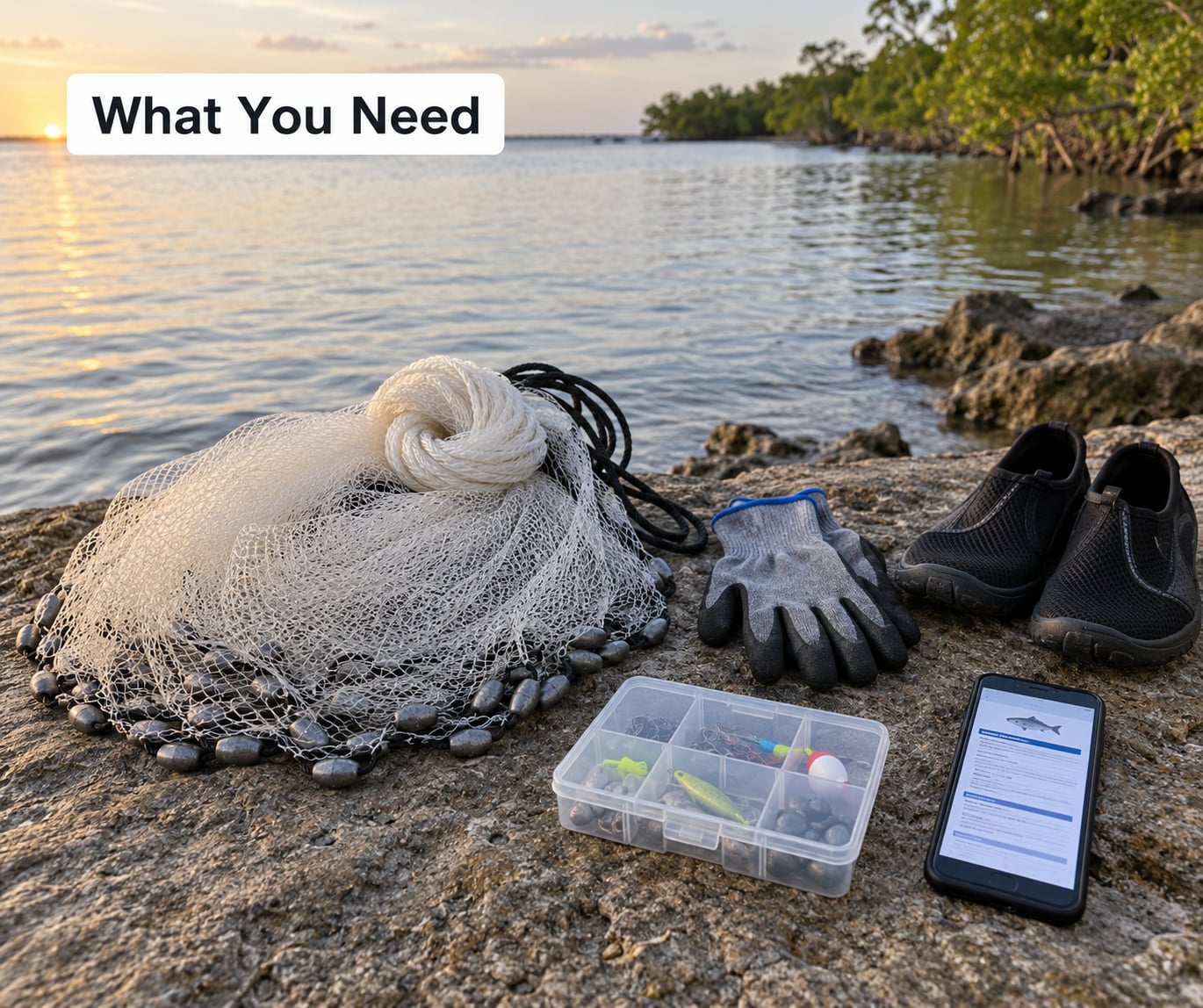
Getting the gear right before you leave the driveway prevents most of the legal problems later, because a compliant net is much easier to buy than to un-deploy once you are standing in the water.
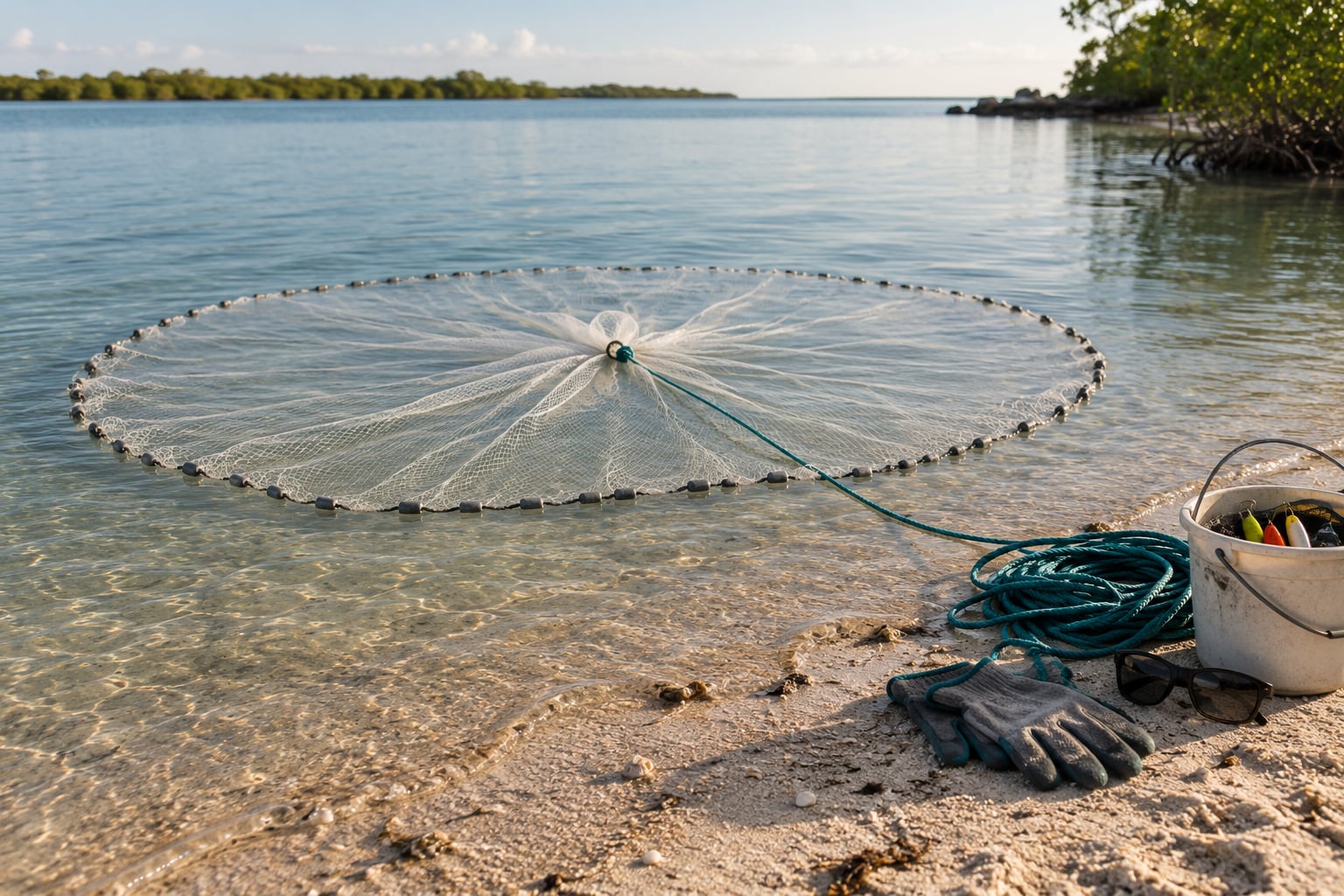
- A cast net you can measure. Know its diameter in feet and its mesh in inches before you buy it, not after. Many states write the limit as a radius, so a 14-foot rule often means a 7-foot net, not a 14-foot one.
- A tape measure. Nets are often bigger than the label suggests once the weighted perimeter is stretched out.
- Work gloves. A lead or chain weighted edge will grind your hands raw on the retrieve.
- Sunglasses or other eye protection. The weighted edge is on a cord, and a collapsing cast can snap it back at your face.
- Water shoes or cleats. Wet shoreline rocks are the most common way people end a cast-net trip early.
- Retrieval rope with a float. A bright float marks the net if the drawstring slips, and a spool keeps the line from tangling.
- An aerated bucket or bait cooler. Ordinary buckets kill baitfish fast in summer heat.
- Line cutters or pliers. For cutting a net loose when it wraps a piling or a rock.
- Your fishing license, and a screenshot of the state rules page. Cell service is not reliable at most boat ramps and many shoreline spots.
If you fish from a kayak or a small boat, add a paddle leash and a bailer. Nets and currents are a bad combination with a low freeboard.
How to Use a Cast Net Legally: Step by Step
Work through these six steps in order. Each one has a checkpoint, and the checkpoints are what keep you out of a warden’s office rather than the other way around.
1. Check the Rules Before You Use a Cast Net Legally
Open your state wildlife agency’s regulations page and read the section on nets, baitfish and special gear. Look for four numbers or facts: the maximum net diameter or radius, the minimum mesh size, which species you may keep, and which license covers the gear.
Then narrow it down to the specific water. State rules are a floor, not a ceiling. A reservoir, a state park unit, a tribal lake or a municipal pond can all impose stricter limits or ban netting outright, usually with the restriction posted at the boat ramp or on a sign at the access point.
Also confirm where you are in the jurisdiction chain. State waters fall under the state agency. Federal waters and the outer continental shelf fall under federal agencies and regional fishery councils, and tribal waters follow the tribe’s rules, not the state’s. Anglers crossing a state line with a loaded net and a livewell of baitfish are in exactly the situation both systems care about, and federal transport restrictions can apply on top of the destination state’s rules.
Checkpoint: say out loud the max net size, the min mesh, the species you can keep, and the license type for the exact water you are fishing. If you cannot, keep reading.
2. Choose a Safe, Appropriate Location
A cast net spreads a weighted circle roughly 8 to 14 feet wide, and it lands about as fast as you can throw it. Choose a spot where that circle has nowhere dangerous to go.
- Stay well clear of swimmers, wading anglers, boat ramps, marina lanes and moored boats. Some jurisdictions set a standoff of around 200 yards from certain structures, and anglers on fishing forums report that distance as a practical minimum, not a guarantee.
- Avoid power lines, overhanging branches, pilings, seawalls and submerged stumps.
- Check the wind. Cast with the wind at your back so the net opens away from you instead of folding onto your feet.
- Look for the structure baitfish like: the lee side of a point, a drop-off near a channel edge, a grass line in summer, a tide change at a boat ramp, or a concentration of small birds working the surface.
- Skip swim beaches, posted no-net areas and any water with a closure sign on it.
Early morning and the hour around a falling or rising tide usually put more bait in the water, and both mean more people on the water too. Pick the quieter of the two.
Checkpoint: you can make a full cast in one direction with the net landing on open water and no person, boat or structure inside the spread.
3. Inspect and Prepare the Cast Net
Lay the net out on flat ground and work along it from the drawstring to the far edge.
Measure the diameter yourself and write it down. Then check the mesh, and measure it stretched rather than slack, because that is the measurement most regulations mean when they name a mesh figure.
Run your fingers along the weighted perimeter looking for breaks in the lead line or chain, check the swivel and both attachment points, pull the drawstring hard, and inspect the retrieval rope for chafing.
Wetting the mesh lets it load tighter and cast more predictably, so give the net a dunk in the shallows before you coil it. If you are the type who learns by feel, tie a small colored tab on the leading and trailing sections. Beginner nets that ship without tabs or braille lines get organized once and then unravel every time they are thrown.
Checkpoint: your measured diameter and stretched mesh both sit inside the limits for that water, and no weight, swivel or rope shows damage.
4. Learn the Basic Cast Technique
Every cast net throw comes down to four things: gather, loop, snap, spread. Beginners get most of their misses from rushing the gather, so practice on land first.
Gather the net into a loose bundle in your trailing hand with the weighted edge in your leading hand. Make a single overhand loop from the horn section, swing your leading arm out and across your body, and release on a forward wrist snap. The lead line carries the perimeter outward, the mesh follows, and the circle opens flat.
The mouth method, where the loop rides in your mouth, needs almost no practice but it is hard on the teeth and impossible with a lot of dental work. The no-mouth method, holding the loop in the leading hand instead, costs you a little reach and gives you the same result. Try both and keep the one you can repeat ten times in a row.
Never step forward into your own cast. If the net is going too far, it is because you swung too far, not because you need more leg drive.
Checkpoint: the net opens into a full circle on flat ground, and the weighted edge lands evenly on all sides instead of bunching into a taco.
5. Let the Net Sink and Work From the Line
A cast net works because the weights sink and fold the mesh underneath the school. Let it sit for a few seconds, no more, then start the retrieve. Dragging the net across the bottom picks up sticks, rocks and a tangled mess of line.
Keep the retrieval rope coiled in your hand or on the spool. Never wrap the line around your wrist or fingers, and keep slack out of it so the net does not ball up underneath.
Spacing matters as much as depth. Cast parallel to other anglers rather than across their line, say hello before you throw, and keep your net clear of anyone else’s float, downrigger or crab pot line. If a boat comes into the area, pull your net in. Propellers and cast nets are a combination nobody wins.
Checkpoint: the drawstring is closed, the net is visibly stacked on the bottom, and you can point to exactly where it sits without guessing.
6. Retrieve, Secure, and Handle the Catch Responsibly
Pull the retrieval line hand over hand, slowly, until the float and drawstring come within arm’s reach. Close the drawstring, then lift the net with the catch hanging on the far side from your body. Keep the weighted edge pointed away from your legs the whole time.
Now go through the net fish by fish, which is also the compliance check. Keep only legal baitfish within the size and bag limits for that water.
If a gamefish with a legal size limit ends up in the net, release it immediately. That single habit comes up more often than anything else in angler discussions about cast net rules, because most states treat cast nets as a bait-fish tool.
Baitfish go straight into aerated water. Anything you cannot identify goes back.
Before you leave, take every piece of gear with you. Line, rope and net fragments left behind kill birds and fish, and a leftover net is exactly the kind of evidence a warden photographs. If the net is wrapped around a piling and will not come free, cut it away rather than dragging the whole mess across a neighbor’s dock. If you are heading home with live bait, check the destination state’s rules and any federal transport restrictions before you cross the line.
Checkpoint: nothing of yours remains in the water, and every fish in the bucket is legal for that water today.
Common Mistakes
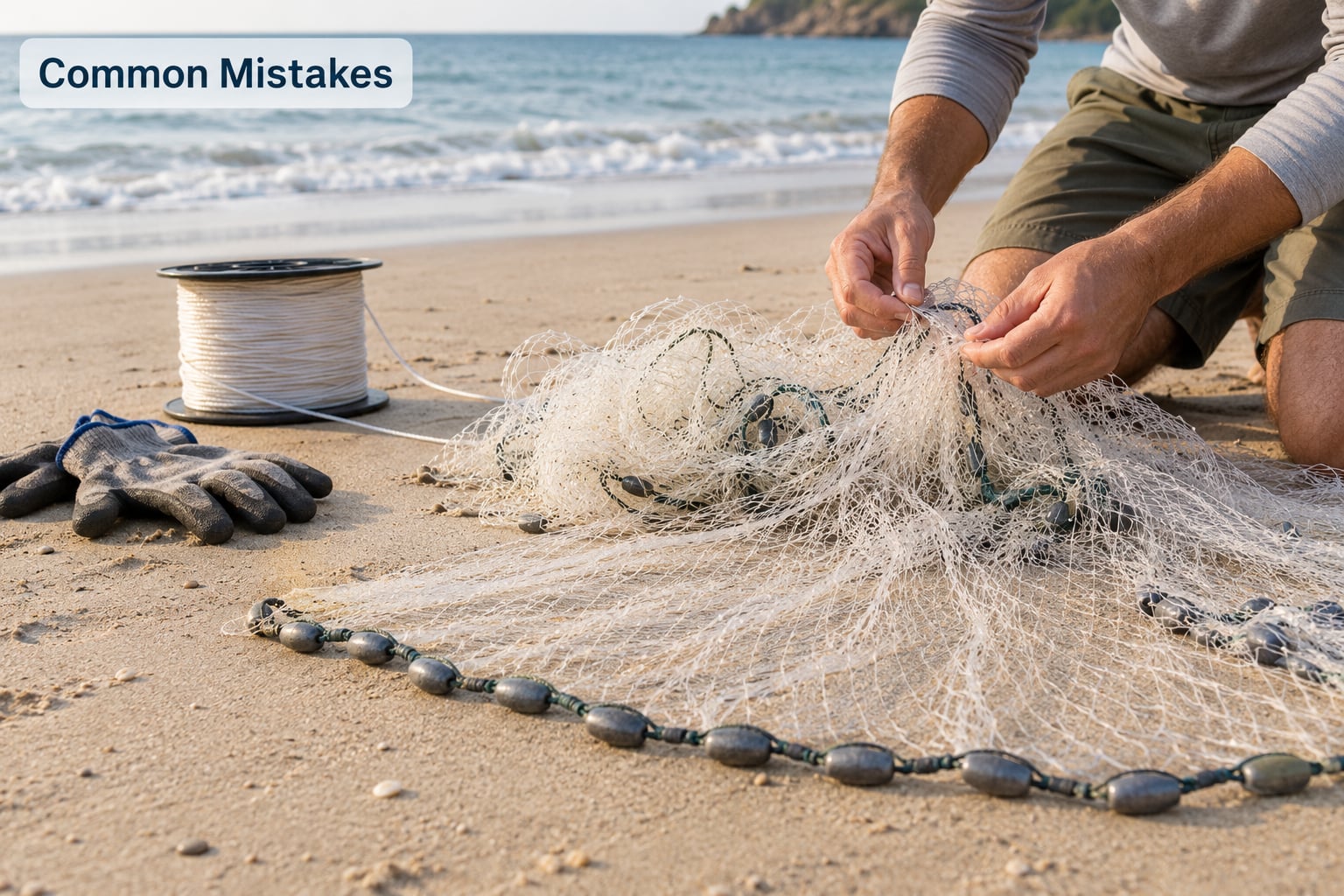
Nearly every cast net citation traces back to one of a handful of avoidable errors, and most of them are legal errors rather than throwing errors.
- Reading a radius limit as a diameter. A 14-foot rule is often a 14-foot diameter, and a stated radius of 8.5 feet means an 8.5-foot radius, which is a 17-foot circle. Measure the net, not the box.
- Buying mesh smaller than the rule allows. Undersized mesh picks up small gamefish and occasionally protected species, which turns a legal gear problem into a possession problem.
- Assuming the standard license covers nets. A few states require a separate permit or a special endorsement for cast and throw nets, and a handful of waters restrict them to resident license holders.
- Trusting the statewide rule over the posted sign. The sign at the ramp is the rule that applies to you that day.
- Casting near people. A weighted net thrown at shoulder height does not care what you meant by it. Pick a new spot.
- Keeping a gamefish. The cast went in, the fish is legal size, and it still has to go back in most states.
- Rushing the retrieve. Pulling the line faster than the mesh drains is how a good cast turns into a snarl and a lost net.
- Leaving gear behind. Retrieve every rope and every scrap of net, and cut the net free rather than abandoning it.
- Assuming last year’s rules. Regulation books get revised through the season. A quick check the morning you leave costs less than a citation.
One habit covers most of the above: after every trip, note the date, the water and the license type you fished on. When a warden asks, you can show you know the rules and were following them.
Frequently Asked Questions
Is it illegal to use a cast net?
Not in most US states, but it is heavily restricted. Cast nets are usually permitted only to take baitfish and non-game species, and only within limits on net diameter or radius, minimum mesh size, licensing and where you can fish. Some states require a special permit, some restrict netting to resident license holders, and some waters ban it outright. Read the current regulation book for the specific water before you cast.
Is a 7 foot cast net legal in Texas?
Anglers report that Texas saltwater rules allow cast nets up to 14 feet in diameter, which is a 7-foot radius, so a 7-foot net falls inside that limit. Inland rules are handled separately and freshwater limits can differ from the coast. Confirm the number in the current Texas Parks and Wildlife regulations before you fish, since the book is revised and saltwater and inland chapters do not match.
What size cast net can you use in Florida?
Florida saltwater rules are commonly reported as a 14-foot maximum diameter, and anglers often choose a 12-foot net for better accuracy and easier handling from shore or a small boat. Florida freshwater is reported by many anglers to have no diameter restriction, though mesh and species rules still apply. Verify the current numbers on the state agency site, and check any waterbody-specific order for the lake or bay you picked.
In what states are cast nets illegal?
There is no single state where every cast net is banned, but cast netting is restricted or prohibited in many places. California is reported by anglers to have regional limits and outright bans in parts of the southern coast, Pennsylvania reportedly requires a permit on certain waters, and individual lakes, state parks and municipal waters across the country close netting by local rule. Always check the water-specific rules, not just the state book.
Can you use a cast net in California for bait?
It depends entirely on the region. Anglers on California fishing forums describe cast net use as heavily restricted along parts of the southern coast, with some areas closed to netting while other areas allow it under state regulations. Marine waters and inland waters are governed differently, and some nets are limited to specific permitted fisheries. Check both the state department of fish and wildlife rules and any regional closure before you plan to collect bait.
Can I transport baitfish I caught in one state to another?
Sometimes, but you need to check two sets of rules instead of one. The destination state may limit or prohibit transporting live bait outright, restrict it to species you may not have, or require the bait to come from an approved source. Federal transport restrictions can also apply when live bait crosses state lines, and many states treat bait from a distant water as a disease risk. Verify both agencies before you load the livewell.
Conclusion
Start on paper, not at the water. Read the current rules for the exact water, write down the max diameter or radius and the min mesh, measure the net in your hands, and pick a spot where an 8-to-14-foot spread cannot land on a person. Cast with the wind at your back, let the weights do the work, retrieve slowly, release anything you are not certain about, and take every rope home with you.
Rules change. Check the state agency page each season, and when in doubt, ask the game warden standing at the ramp. They would rather answer a question than write a ticket.