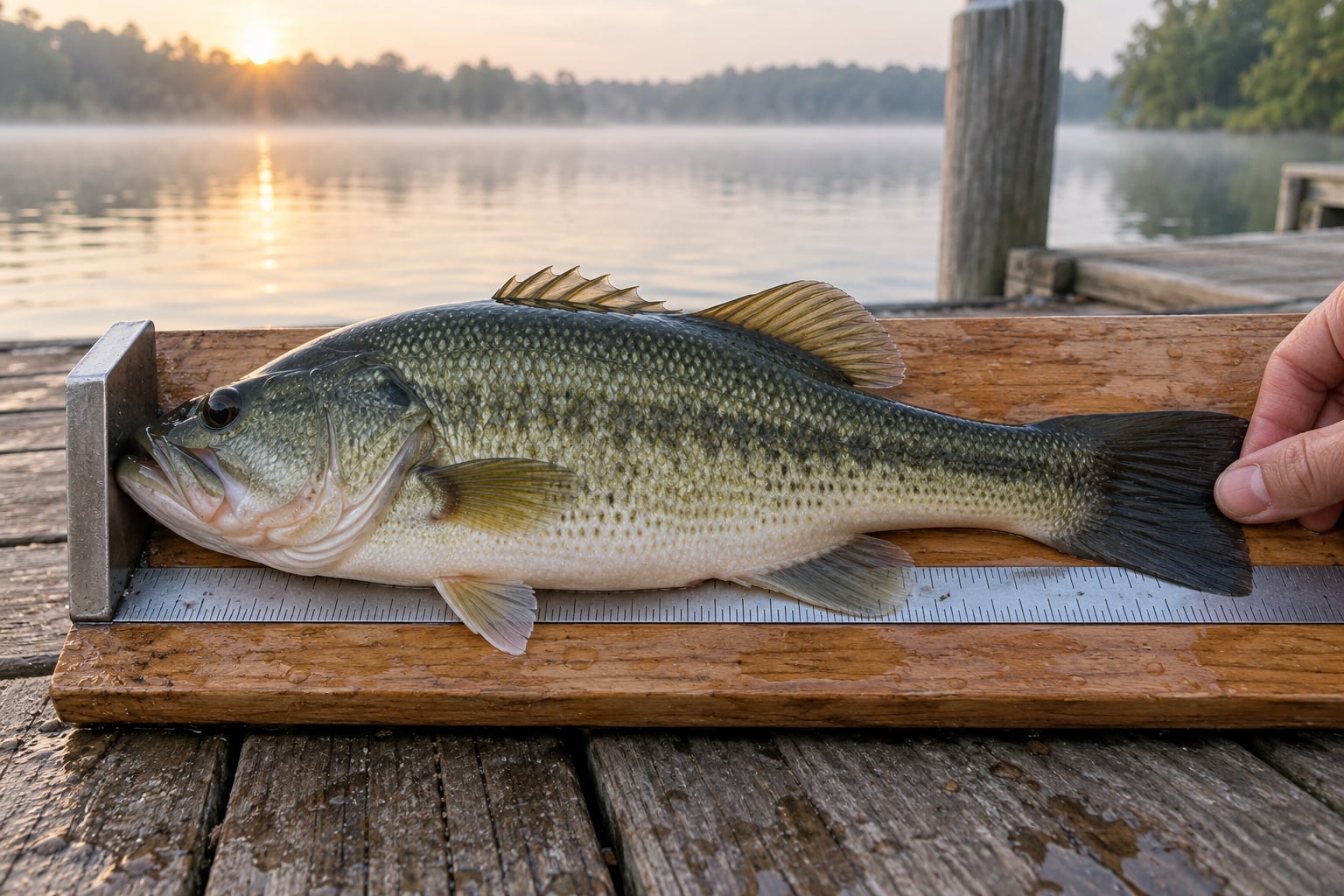
To measure a fish correctly, lay it on its side on a flat, rigid board, close the mouth, press the snout against a perpendicular end stop, and squeeze the tail lobes together to get the longest straight-line reading. The two rules that decide whether a fish is legal are a shut jaw and a fully compressed tail.
That takes about fifteen seconds once you have done it a few times. It also decides whether you keep a fish, release it, or walk away with a citation, because a warden or a tournament judge works from the same number you do.
Most of the confusion comes from one thing: different agencies measure different parts of the fish. The same 16-inch bass can be 16 inches by total length and only 14 by fork length, and those two numbers come from completely different rules. Work out which measurement your water requires first, then take the reading.
This guide covers the tools worth carrying, the seven-step technique that gives a repeatable number, the measurement types mapped to the bodies they belong to, and the errors that get good fish thrown back. It applies to freshwater and saltwater, kept and released, from a 6-inch bluegill to a wahoo.
Table of Contents
- 1What You Need
- 2Step-by-Step
- 3How to Measure a Fish Correctly: Use the Right Reference Point
- 4Place the Fish on a Flat Surface
- 5Straighten the Head and Tail
- 6Read the Measurement Where the Body Ends
- 7Round and Record the Result
- 8Check the Measurement Twice
- 9Handle and Release or Store the Fish
- 10Common Mistakes
- 11Measuring with the mouth open
- 12Measuring along a curved body
- 13Reading to the tail base
- 14Leaving the tail loose or fanned
- 15Guessing from memory and rounding later
- 16Using a board that is too short
- 17Using the wrong length type for the water
- 18Frequently Asked Questions
- 19What is the correct way to measure a fish from nose to tail?
- 20Should I measure to the end of the tail fin or the tail base?
- 21How do you measure a fish that is curved?
- 22Do all fish species use the same measurement method?
- 23Can I use a measuring tape or my phone to measure a fish?
- 24Conclusion
What You Need
The tool matters less than most people think, and it matters mostly in one respect: it has to give you a fixed starting point. A surface with a hard edge standing straight up at zero is what removes the guesswork from where the fish begins.
A rigid board with a perpendicular end stop. This is the bump board, and it is the standard for a reason. Fish anglers on the bass forums reach for one constantly, and tournament anglers almost never measure off anything else. The raised end at zero means the snout cannot drift, so the only variable left in the reading is the tail.
A measuring ruler long enough for the fish. Here is where anglers get burned. A lot of the fish rulers sold online stop at 21 inches, which is fine for bass and trout and useless the moment someone hooks a 30-inch striper. Anglers on r/bassfishing have complained about exactly this and end up measuring in two passes, or guessing. For anything that could run past 20 inches, look for a board in the 30 to 50 inch range, or a 200 cm board if you might see halibut.
A waterproof notebook or a phone with a waterproof case. A fish measured and then forgotten is a fish you cannot brag about, and slot limits are hard to argue without a record of the date and the water.
Optionally, calipers or a jawed fishmeasurer. Useful for the odd jobs rather than the standard one. A caliper gives you an exact girth reading for weight estimation, and a jawed measurer gives you a set mouth for the repeated snapper and cobia measurements that show up on coastal docks.
Flexible tape measures get a bad reputation, and most of it is deserved. A tape follows the curve of a body instead of a straight line, so it reads long on any fish that is not perfectly straight on the board. A tape is fine for girth, where a curve is the point, and wrong for total or fork length. If you use one for length, lay the fish as straight as you can and keep light tension so the tape does not bow.
Tool choice mostly follows fish size and where you are. On a small inland lake where the legal fish are trout, panfish and bass, a 21-inch ruler is enough and fits in a vest pocket. At a coastal dock or on a bigger lake, a longer bump board matters more than any other feature. Measuring on a wet boat deck in the rain argues for a board with a non-slip surface and a raised end, because the failure mode there is a fish landing on the floor mid-measurement.
Sometimes you have no board at all. You took the photo, the fish is already in the water, and the number still matters for your log. A photo can get you close if you work at it:
- Find a reference object of known size in the same plane as the fish: a boat gunwale, a cooler, a tackle box, a length of trailer rail.
- Keep the camera directly above and square to the fish, or the perspective error alone can add an inch or more.
- Measure the snout-to-tail axis on screen in proportion to the reference object, not the reference alone.
- Add an inch of caution. A photo reading is an estimate, and it will not settle an argument with a game warden.
Step-by-Step
How to Measure a Fish Correctly: Use the Right Reference Point
A correctly measured fish is recorded from the tip of the closed mouth or snout to the end of the tail, with the jaw and the tail lobes folded into their normal measuring position. The reading does not stop at the tail base, and it does not run to the top of a splayed tail either.
Which point on the far end counts depends entirely on the rule you are measuring to. The table below maps each measurement type to its start point, its end point and the places it actually gets used.
| Measurement | Start point | End point | Where it is used |
|---|---|---|---|
| Total length (TL) | Tip of the snout, mouth closed | End of the tail fin, lobes squeezed together | Most state harvest regulations; the default freshwater method |
| Fork length (FL) | Tip of the snout, mouth closed | The notch where the tail lobes split | Federal and saltwater rules, and many state agencies |
| Standard length (SL) | Tip of the snout, mouth closed | End of the caudal peduncle, where the fin attaches | Fisheries research and tagging programs |
| Lower jaw fork length | Tip of the lower jaw | The fork in the tail | Marlin and billfish |
| Curved fork length | Tip of the snout | The fork, measured along the curve of the body | Tuna, sharks and other curved swimmers |
| Carcass length | Front of the gill opening | End of the caudal keel | Federal waters, including the Gulf of Mexico |
| Girth | Widest point around the body | Widest point around the body | Weight estimation, not size limits |
Texas Parks and Wildlife Department and the Florida Fish and Wildlife Conservation Commission both split their rules by species, and Louisiana Department of Wildlife and Fisheries guidance separates state waters from federal waters, where carcass length can replace fork length. The pattern to learn is simple: find the species in the regulation, then find which length type the sentence uses. Wording like measured from the lower jaw, or along the curve of the back, is a fork-length variant and is not interchangeable with total length.
Place the Fish on a Flat Surface
Set the fish on its side on the board, head against the end stop. Wet the surface first if you are working on a slick deck, because a wet fish on a dry board slides, and a sliding fish gets a wrong reading every time.
Keep the whole fish supported along its length. A fish hanging off the end of a short board droops at the tail, and the droop shortens your measurement without you noticing. This is the failure anglers hit with those 21-inch rulers and a 24-inch trout: the tail is off the board, hanging, and reading short. Get a second pair of hands or a longer surface before you blame the ruler.
Hold it firmly but gently. A wet bass is strong and a catfish has spines, so control the fish at the head and behind the dorsal area rather than clamping the body.
Straighten the Head and Tail
Push the snout firmly into the end stop so the jaw is shut and the head is not tilted. A fish held with its head slightly up or turned toward you measures short, sometimes by a surprising amount on a big head.
Then take up the tail. Squeeze the two caudal lobes together between thumb and fingers so the fin reads as one straight edge, and lay it along the ruler. This is the step anglers argue about, and the StripersOnline thread on pinching the tail versus using the top tip shows how loudly it gets debated. The regulation is what settles it: where the rule says total length, you compress the lobes, and where it says fork length, you stop at the notch and the debate never started.
Compressing rather than fanning is what agencies specify, because a fanned tail measures the spread of the fin rather than the length of the fish. Fins also tear, and a torn lobe gives you a shorter reading than the fish deserves, which is the opposite of what you want on a fish you plan to keep.
For anything large, get a second person. One holds the head against the stop, the other works the tail flat and reads the scale. A fish twisting mid-measurement is the single most common source of a number nobody can reproduce later.
Read the Measurement Where the Body Ends
Read at the far end of whatever point your rule calls for, and read against a hard surface. Pinch the tail lobes, note where the tip of the pinched fin meets the ruler, and read that line straight across.
Two habits make readings more reliable. First, put a finger on the scale at the endpoint so your eye and the line land in the same place. Second, read the number that is clearly behind the endpoint, not the exact line itself, and note that as a conservative estimate.
On a curved-body species such as a shark or a tuna, the rule already tells you to follow the curve, which is the one case where a flexible tape is the correct tool rather than the wrong one.
Round and Record the Result
Round the way the receiving rule wants. Tournament divisions often specify rounding up to the next inch, and some specify rounding to the nearest quarter inch, so check before you commit. A personal log does not care, but writing 16 3/8 is more useful later than writing 16.
Write down the number, the unit, the species, the date, the water and the measurement type you used. That last one is the field people leave blank and then regret. A log that says bass, 17, June is a nice memory; a log that says bass, 17 inches total length, June, lake, is a record you can check against a limit and a map.
For photos, take the picture with the board visible and the number in frame, or with the fish and the board in one shot. Later, a photo plus a written length is a record that holds up.
Check the Measurement Twice
Run the whole thing a second time before you photograph the fish or commit to a decision about keeping it. Most wrong readings come from one of four places, and each is quick to catch on a second pass:
- The mouth was open. Check the jaw is actually shut against the stop.
- The body curved. Look down the fish from above; it should read as a straight line.
- The tail was loose or fanned, not compressed into one edge.
- You read the wrong scale mark in dim light or a moving boat.
If the two readings disagree by more than a fraction of an inch, take a third. Disqualifications over measurement are real in tournament fishing; a WalleyeCentral thread about records being set for disqualifications at a Cabela’s event makes the point that the procedure, not the fish, is what ends the day. A third pass costs seconds and removes the doubt.
Handle and Release or Store the Fish
Release fish promptly, and keep them out of the air as little as possible. Wet your hands before you pick the fish up; the slime layer on a trout’s skin is its first line of defense against parasites and infection, and a dry grip takes it with you.
A fish that goes back needs to go back in the right place. If it came off a ledge, put it near the ledge. A fish that has been measured while hanging vertically is not a fish that swims off cleanly, so support it in the water for a few seconds and let it regain its balance before you let go.
For a fish you intend to keep, get it on ice or into a cooler with ice right away. Two things shrink a measured fish: the handling delay, and then the bleed-out. If you are driving home before cleaning it, a fish measured at the boat and weighed at the dock will not be the same fish in either direction, and knowing that saves an argument with a scale.
Common Mistakes
Almost every rejected fish comes down to one of these, and each has a simple fix.
Measuring with the mouth open
An open jaw adds real length, sometimes half an inch on a bass, and it is the easiest way to convince yourself a short fish is legal. Close the jaw and press the snout into the end stop before you look at the scale at all.
Measuring along a curved body
A fish lying in a slight C reads long with a flexible tape and short with a straight ruler if the tail is tucked. Straighten the spine or use a rigid board; never rely on the tape to tell the truth about a curved fish.
Reading to the tail base
Standard length and total length are different measurements, and using the wrong one can put you on the wrong side of a legal limit. Confirm which one your regulation names before you decide a fish is a keeper.
Leaving the tail loose or fanned
A free tail curves, drifts or swings, and the reading becomes a moving target. Compress the lobes into a single flat edge and hold them there while you read. A torn or chewed lobe also shortens a total-length reading unfairly, which is one more reason to keep the fish wet and the handling short.
Guessing from memory and rounding later
Anglers report eyeballing a number in the field and rounding to the nearest inch after the fact, which is how a limit gets missed. Write the reading at the board, while the fish is still next to the ruler.
Using a board that is too short
If the tail hangs off the end of the ruler, the number is not a measurement. Use a longer board, or measure in two passes from a fixed mark and add the two readings carefully.
Using the wrong length type for the water
The most expensive error is the quiet one: measuring correctly for the wrong rule. eRegulations’ Pennsylvania guide, for example, is explicit that the record is the total length with the tail slightly compressed, and using fork length there produces a fish that looks legal and is not. Look up the rule for the specific water before the trip, not at the dock.
A few habits fix most of this. Keep a board in the boat rather than in the truck, so the reading happens at the side of the boat where the decision gets made. Print the limit and the length type for your target species on a card and keep it in the same compartment. And measure two fish at the start of a trip purely to practice, then release them, so the first fish that matters is not your first attempt.
Frequently Asked Questions
What is the correct way to measure a fish from nose to tail?
Lay the fish on its side on a flat, rigid board or ruler, close the mouth completely, and press the snout against a perpendicular end stop at zero. Squeeze the tail lobes together into one flat edge, then read the ruler at the tip of that edge for the longest straight-line length. The reading is the tip of the closed mouth to the end of the tail fin, not the tail base.
Should I measure to the end of the tail fin or the tail base?
It depends on which measurement your regulation names. Total length runs to the end of the tail fin with the lobes squeezed together, and it is the default for most state freshwater rules. Fork length stops at the notch where the lobes split, and standard length stops where the fin joins the body. Read the species rule first, then measure to that point.
How do you measure a fish that is curved?
Straighten it first. Put the fish on its side, hold the snout against the end stop, and gently straighten the spine so the body runs parallel to the ruler before you read. If the rule specifically calls for a curved measurement, such as curved fork length for tuna and sharks, then follow the curve of the back with a flexible tape instead of a rigid board.
Do all fish species use the same measurement method?
No. Species and waters differ, and so do states. Total length is the most common freshwater method, fork length is standard in many federal and saltwater rules, lower jaw fork length is used for marlin, carcass length appears in some federal Gulf waters, and rays are often measured by disc width. Always check the rule for your specific species and waterbody rather than assuming a neighboring state’s method.
Can I use a measuring tape or my phone to measure a fish?
A flexible tape works for girth, and that is what it is good for. For total or fork length it reads long on a curved body because it follows the curve instead of a straight line, so a rigid board is the better tool whenever accuracy matters. A phone photo can give a reasonable estimate if you include a reference object of known size, but treat that as a log entry, not a legal measurement.
Conclusion
Start with the rule, not the ruler. Find the measurement type your lake, your state agency or your tournament requires, then apply the same seven steps every time: rigid flat surface, snout against a hard end stop, jaw shut, body straight, tail lobes compressed, read at the true end point, check it a second time. Fifteen seconds of that keeps a legal fish and a good day on the water.