The fastest way to be a well-liked boater is simple: prep your boat away from the ramp, launch promptly once you reach the top of the lane, then get both your boat and your tow vehicle out of the way. Get that sequence right and the boat ramp etiquette mistakes to avoid are all but impossible to commit.
Most of the bad behavior at a launch site is not rudeness, though it feels like it from the line behind you. It is unpreparedness. A boat that has no fenders rigged, no drain plug in hand and no spotter waiting is a boat that will sit in the middle of the ramp for ten minutes while a hundred strangers watch.
I have spent enough seasons at busy ramps to know the pattern well: whoever does the prep work at home gets down the ramp in a couple of minutes. Everyone else is still untangling a strap while the next driver is already in position. This guide walks through the ten mistakes I see most often, what actually goes wrong with each one, and what to do instead. Updated for the 2026 boating season.
A note before we start, because etiquette at a ramp is really two things wearing the same clothes. Some rules are universal: do not block the lane, do not leave floating boats tied to the ramp, pack out your line and litter. Other rules are posted locally: ramp hours, launch fees, permits, whether a trailer must be pulled completely out of the water before you leave. Read the sign at every ramp you visit, because those local rules are the ones with consequences.
Table of Contents
- 1Boat Ramp Etiquette Mistakes to Avoid at a Glance
- 21. Jumping the Queue or Ignoring the Ramp Queue
- 32. Preparing the Boat While Blocking the Ramp
- 43. Launching Too Fast or Losing Control
- 5Why these boat ramp etiquette mistakes hurt more than they look
- 64. Backing Down Without Checking Behind the Boat
- 75. Leaving the Trailer Parked in the Water
- 86. Returning Without a Clear Loading Plan
- 97. Using the Wrong Trailer or Staging Spot
- 10Night launches and landings with no painted lines
- 118. Ignoring Courtesy Between Vehicles
- 129. Leaving Trash, Fishing Line, or Litter Behind
- 1310. Skipping Post-Launch and End-of-Day Checks
- 14Frequently Asked Questions
- 15Who goes first at a busy boat ramp?
- 16Should I wait in my vehicle until the boat is ready to launch?
- 17Do I need a spotter when backing a boat trailer down a ramp?
- 18What should I do if another driver cuts into the launch line?
- 19Are boat ramps responsible for cleaning up oil, fishing line, and litter?
- 20Conclusion: What to Do First
Boat Ramp Etiquette Mistakes to Avoid at a Glance
Here is the whole list in one table, with the fix next to each problem so you can scan it in the parking lot before you get in line.
| Mistake | Why it is a problem | What to do instead |
|---|---|---|
| Cutting into the launch queue | Creates two boats in one lane and a recovery job for everyone | Join the line of tow vehicles and wait your turn |
| Rigging and loading at the top of the ramp | Turns a two-minute stop into a ten-minute block | Finish fenders, lines and tie-downs in the staging area |
| Entering the water too fast | The boat has no brakes once it floats and can broach | Idle off, keep it straight, ease the throttle up |
| Backing down without looking behind the trailer | Struck vehicles, pilings and swimmers are all in that blind zone | Use a spotter or get out and walk the lane first |
| Leaving the trailer sitting in the water | Holds the lane and sometimes the shoreline clear of a parking spot | Pull to the staging or parking area as soon as the boat floats |
| Retrieving with no loading plan | Backs the whole line up while gear gets sorted | Load before you enter the lane and use one spotter |
| Parking in a long-term spot or the wrong lane | Blocks the staging lane everyone else needs | Follow signs and the ramp attendant’s directions |
| Ignoring turn-taking and communication | Two drivers assume they have the ramp at the same time | Wave the next driver in and keep the exchange civil |
| Leaving line, bait and litter behind | Lost line kills birds, bait attracts rats, litter washes downstream | Pack out everything and use a bin, not the bank |
| Skipping the end-of-day check | Loose gear, an open plug or an unsecured boat is a hazard for the next crew | Secure, inspect, retrieve and report damage before you drive off |
The common thread is that every one of these hurts a stranger first. That is what makes ramp etiquette different from ordinary manners at a marina, where nobody is waiting on you with a trailer behind yours.
1. Jumping the Queue or Ignoring the Ramp Queue
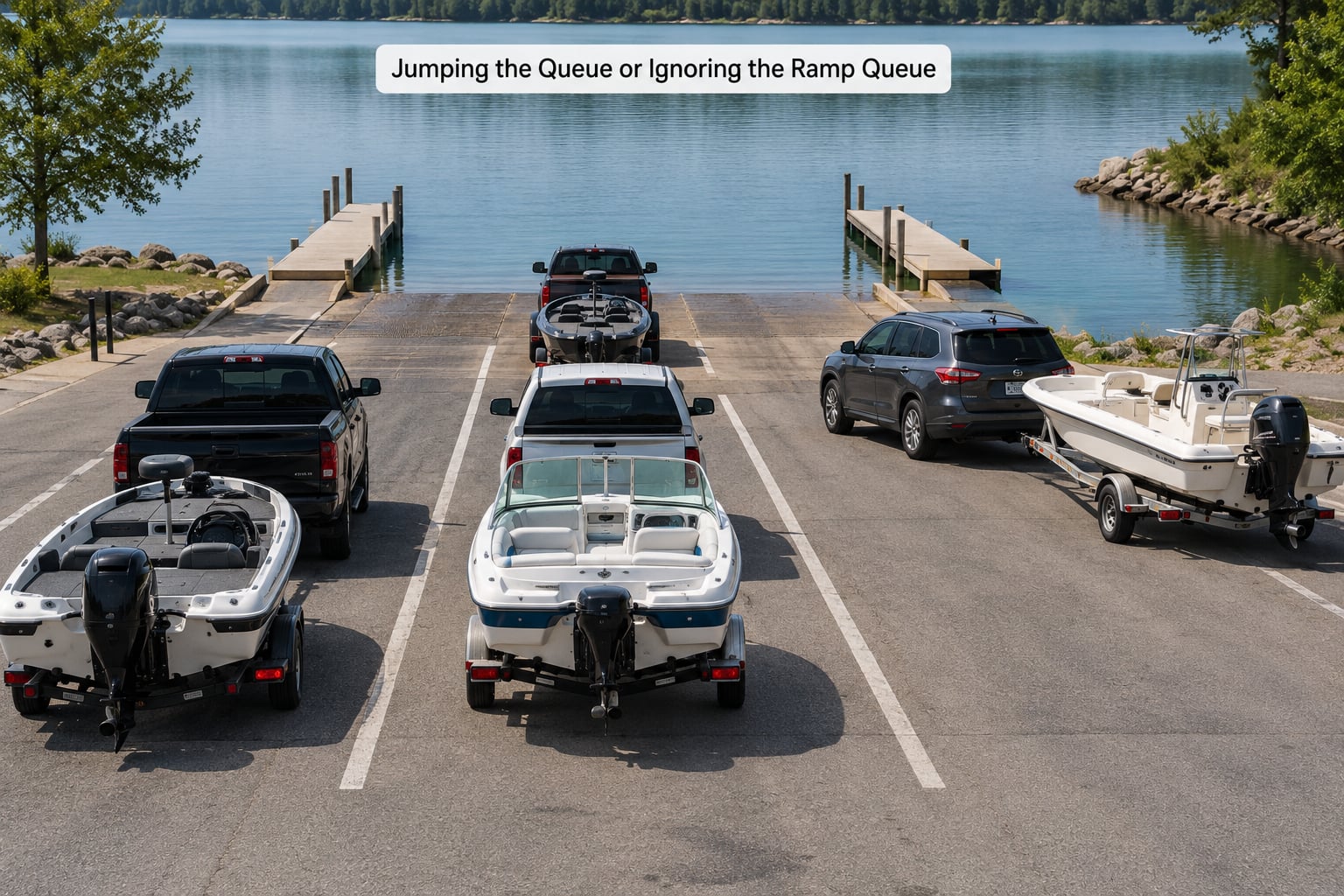
Whoever is in position at the top of the lane launches next. At a ramp with an attendant or a marked staging line, the order is usually the order the vehicles arrived, and the person holding the line has the right of way.
Skip that and you create a genuine hazard, not just an annoyance. Two boats in one lane means somebody has to abort mid-launch or back out while a hull is already moving. On a multi-lane ramp, people often see an empty side lane and assume it means priority. It does not, unless an attendant says so. Wait your turn even if the guy who just launched spent fifteen minutes on the ramp.
Instead: pull into the line with the rest of the vehicles, keep your trailer straight and ready to go, and let the person ahead launch. At an unstaffed ramp with no markings at all, pull off to the side and let boats already on the water finish launching before you set up.
2. Preparing the Boat While Blocking the Ramp
Fenders rigged on the ramp, a cooler being loaded at the trailer tongue, a bow line still coiled under the winch: this is the single most complained-about behavior on any forum thread about ramp manners, and it is usually just habit. The driver moved the boat to the ramp because the boat was already at the ramp.
Work through your checklist in the staging area or your parking spot instead. Fenders on, bow line ready and coiled, stern line ready, drain plug in your pocket and installed, tie-down straps off or loose, battery switch in the right position, live well and battery charger hooked up. Trailers with a winch strap are easier to handle from that point too, because you are not doing it in a live lane with someone behind you.
Instead: everything that can be done in the parking lot gets done there. If a boat has to be re-rigged at the ramp, do it to one side, out of the lane, and accept that the queue will wait.
3. Launching Too Fast or Losing Control
Once the trailer stops, the boat has no brakes. Whatever momentum you gave it in the last three feet is what it carries into the lane and toward the bank, dock or ramp structure.
The right sequence is boring: come off the winch in neutral, drop the drive into gear, keep the trailer perfectly straight, and let the boat walk forward on its own. Add throttle only once the hull is fully clear of the bunks and guide posts. Too much throttle too early is how trailers get pushed out of alignment and how props end up chewing trailer frames. A stiff crosswind pushing the boat sideways at the top of the ramp is the classic broach scenario, and the cure is to back up and reassess, not to add power.
Instead: idle speed, straight trailer, hands off the wheel, and abort early if the boat will not come off smoothly. Waiting forty-five seconds to try again beats a damaged ramp and a bent prop.
Why these boat ramp etiquette mistakes hurt more than they look
Ramp damage is expensive and slow to fix. Concrete wears where trailer tires bite, and the person who wears it out is not the one who pays to pour the new slab, which is exactly why the pace and alignment you set on the ramp matters to the next hundred boaters.
The same goes for trucks in the water. A tow vehicle that ends up floating means a recovery crew, a closed lane and a bad day for whoever has to fish it out. The behaviors that cause it are simple: algae-slick surfaces, no park brake set, misjudged water depth, or a trailer that stopped more suddenly than the driver expected.
4. Backing Down Without Checking Behind the Boat
Behind your trailer there is a blind zone roughly as long as the boat is wide, and it contains pilings, dock fingers, swim platforms, other vehicles, children, anglers standing in shin-deep water and whatever the last launch dragged into the lane.
Get one of three things in place before you reverse. Have a spotter on foot with a clear view of the whole lane, walking beside the trailer, hands off the vehicle. Or walk the lane yourself before you start, look for submerged debris, and confirm the depth is enough for the boat to come off the bunks. Or attach a remote or handheld control and watch the camera monitor rather than trusting mirrors alone.
Tow-vehicle back-up cameras and sensors do not know the difference between a piling and a post. Low water exposes obstacles that are invisible at full pool. If you are alone and cannot get a spotter, wait for another launcher to come up, or launch early when the ramp is empty.
Instead: spotter, walk-through, or remote control, every single time. This is safety before it is etiquette, and the two together is why a spotter is worth the two minutes of asking.
5. Leaving the Trailer Parked in the Water
The trailer is not parking. A trailer sitting in the launch lane blocks the next boat, and at a shallow ramp it can block the shoreline approach for everyone behind you.
As soon as your boat floats free and you have control of it, get the boat to the courtesy dock or the mooring area, then pull the tow vehicle and trailer up to the staging area or the parking lot. If the parking area is full, that is a real problem, and people handle it badly. Do not park on the ramp shoulder, do not block an access aisle, and do not leave the trailer pointed down the lane as a space reservation. Park where an attendant directs, and if the lot is genuinely full, ask rather than inventing a spot.
Instead: boat to the courtesy dock, trailer to the lot, both clear of the lane. The person who freed the ramp fastest at your last launch was not the fastest driver. They were the best prepared.
6. Returning Without a Clear Loading Plan
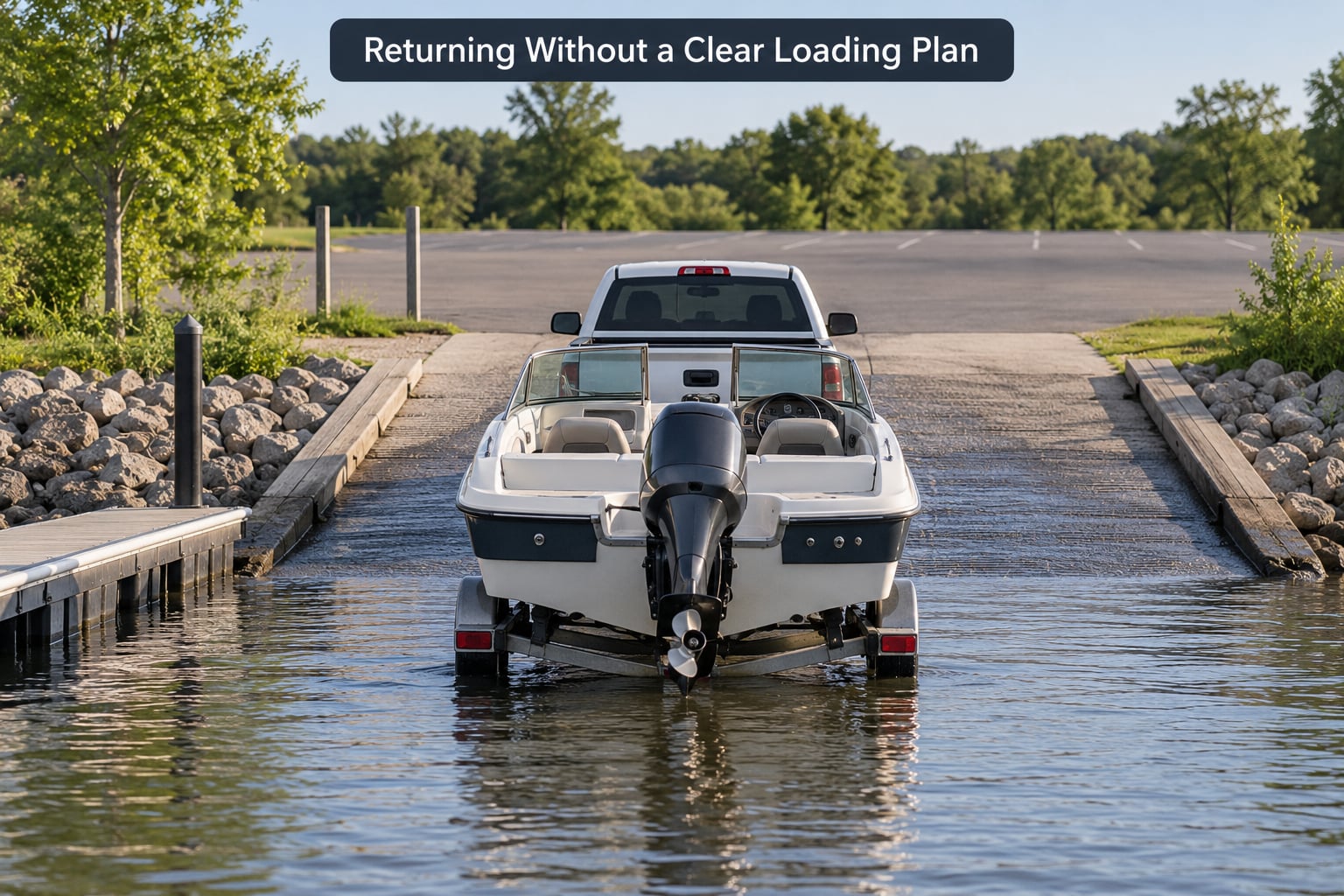
The retrieval line is usually the most crowded part of the day, and it is the part people plan least. Everyone spent the morning thinking about launching. Nobody thought about getting the boat back.
Load before you enter the lane. Coolers in, rods and tackle in, live well shut down, battery charger unplugged and stowed, drain plug handled so it does not end up in the parking lot gravel, tie-downs ready on the trailer bow. Then position with one spotter guiding from the shore side, keeping the boat straight as you bring it up. Secure the winch strap before you move a foot. If the line behind you is backed up, that is the natural rhythm of a busy evening, not something to fix by rushing.
Instead: arrive with a plan, load in the staging area, use one spotter, secure, then pull clear. If your crew is still strapping life jackets on, let them finish before you call for the spotter.
7. Using the Wrong Trailer or Staging Spot
Staging and storage are different jobs. The launch staging lane is a temporary holding area for trailers whose boats are going in or coming out right now. The parking lot is where vehicles and trailers live for the day, the night or the season.
Long-term parking in the staging lane is the most common misuse at busy ramps, and it usually happens because people think the staging lane is a parking lot with a free spot. Read the signs. When an attendant exists, follow them. When none exists, park at the back of the area, keep the lane nearest the ramp clear, and leave yourself room to pull out in the direction of travel instead of backing through the whole row.
Instead: staging lane for launching and retrieving, marked parking for staying. If you are not sure which you are in, park as if someone is launching behind you, because they are.
Night launches and landings with no painted lines
Before dawn and after dark the ramp gets its own short rule book. Run your headlights so the line behind you can see the vehicle in front of it, and leave your own headlights on if you are still in the lane or staging area so the boat behind you can see you. Once you are clear of the ramp area, switch them off so you do not blind the launcher behind you. That tip circulates widely among forum regulars and it is sound.
Carry the right lights for the boat itself, mounted before you leave home rather than at the ramp. On unmaintained landings with gravel, no lines and no attendant, nobody has defined who goes first. Pull to the side, let boats already in the water finish, and take your turn among the vehicles that were there before you. Watch for submerged branches and rocks, expect no traction, and bring boards if the ramp is steep or slick.
Should you use 4×4? On a steep, wet or algae-covered ramp, low range gives you the control you need and the traction you need. It is a tool, not a habit. You still want the trailer to roll freely off the bunks, and a hard throttle in low range on a slick ramp is how bunks get destroyed.
8. Ignoring Courtesy Between Vehicles
The ramp gets tense because everyone is watching a stranger’s trailer over their shoulder. A wave from the top of the ramp is not an interruption, it is a courtesy, and experienced boaters offer it constantly to first-timers on a steep slope.
That goes both ways. If someone waves you a spot, take it, thank them, and do not take offense if they coach you a little. If you are a veteran watching a first-timer lose the alignment, waving them to stop is more useful than saying nothing while they learn the expensive way. On multi-lane ramps, one lane is one queue. Drivers entering a second lane merge at the back, not halfway up.
Instead: turn-taking with eye contact and a wave, one spotter at a time, and no raised voices. A short word with the person ahead of you settles in seconds what an argument settles in minutes, badly.
9. Leaving Trash, Fishing Line, or Litter Behind
A boat ramp is a public shoreline and a boat launch is a place where litter ends up in the water instead of in a bin. Loose line snags wildlife. Bait and fish waste attract rats near the trailer parking. An oil spot or a fuel spill on the ramp surface makes the next vehicle’s tires slippery for everybody.
Bring a bag and put everything in it before you leave the parking lot, not after. Pull your line, hooks and sinkers. Keep a rag for grease and fuel residue so it goes in a bin rather than on the concrete. Check your live well and drain plug pockets for small creatures before you pull out. At lakes with state inspection requirements, drain, clean and dry before you trailer out, and note the inspection sticker date on the boat.
Instead: pack out everything you brought, including the line. If the ramp has no bin, take it home with you.
10. Skipping Post-Launch and End-of-Day Checks
The last few minutes are where a good day gets undone. Boat floating loose at the courtesy dock because the bow line was never tied off. Trailer light hanging by its wire. A cooler lid left open in the parking lot. Drain plug left on the tailgate for the next person to find.
Before you drive away, confirm the boat is tied and the battery and fuel states match what you want for next time. Walk the trailer frame and the wheel wells for debris picked up on the ramp, check the lights and the tires, and look at the ramp itself. If you tore up surface, snagged something or damaged a piling, report it to the ramp attendant or the managing agency instead of leaving it for the next boater to find.
Instead: tie the boat off, retrieve your gear, inspect the rig, and tell someone about damage. Etiquette at a ramp is mostly just finishing what you started.
Frequently Asked Questions
Who goes first at a busy boat ramp?
Whoever is next in the queue, and at a staffed or marked ramp that is usually the order vehicles arrived. On a multi-lane ramp each lane is its own line, so an empty second lane does not mean priority unless an attendant says so. At an unstaffed ramp with no markings, let boats already on the water finish launching, then take your place in the lot with everyone else.
Should I wait in my vehicle until the boat is ready to launch?
Wait in the staging area or your parking spot, not at the top of the ramp. Do everything that does not need the water there: rig fenders, coil the bow and stern lines, install the drain plug, check lights and battery, and stage the load. Drivers who queue with the boat already ready are the ones who float in two minutes instead of parking on the ramp for ten.
Do I need a spotter when backing a boat trailer down a ramp?
If someone is available, yes. A spotter on foot with a clear view of the lane catches pilings, other vehicles, children and submerged debris that mirrors and cameras miss. If nobody is around, walk the lane yourself first to confirm depth and obstacles, and use a remote control with the camera monitor if your vehicle has one. Launch alone early in the morning when the ramp is empty.
What should I do if another driver cuts into the launch line?
Keep rolling to a safe stop and let them finish rather than trying to squeeze past. Do not park your trailer across the lane to block them, because that is how two hulls end up in one lane. If nobody intervenes, it is usually safe to wave the next vehicle in behind them so the line keeps moving. If a lane becomes genuinely blocked, that is a good moment to ask the driver politely, once.
Are boat ramps responsible for cleaning up oil, fishing line, and litter?
Most ramps are maintained by a city, county, state agency or private operator, and they usually handle routine trash and restroom upkeep. Boaters are still expected to pack out their own line, hooks, bait, fish waste and litter. Spilled oil and fuel are a different matter: report them to the ramp attendant or the managing agency right away, since a slick ramp surface causes a crash for the next driver.
Conclusion: What to Do First
If you take three things away, make them these: do the prep in the staging area so you queue with a ready boat, check behind the trailer with a spotter every single time, and clear both the boat and the tow vehicle out of the lane as soon as you are afloat. Those three cover most of the boat ramp etiquette mistakes to avoid, and they take about two extra minutes at home.
The rest is just finishing what you started. Tie your boat off, pack out your line, and wave the next driver in. That is the whole standard.