To keep food safe from animals while camping, store every item of food, trash and scented product in a bear-resistant locker, a certified bear canister, or a properly built hang, and keep perishable food at 40°F or below the whole time. That covers two separate problems: wildlife getting into your supplies, and bacteria growing in food that got warm.
Most campsites need both halves done well. Bears are not the only animal at your table either. Raccoons, mice, marmots and chipmunks are far more common, and they are usually the reason a camper’s food gets ruined.
Here is the setup, start to finish, so you can get it right before you leave home rather than at 9 p.m. in the dark.
Table of Contents
- 1What You Need
- 2Step-by-Step
- 31. Plan Your Meals Before Leaving Home
- 42. Keep Everything Cold in a Properly Packed Cooler
- 53. Store Food and Trash in the Right Location
- 64. Prepare and Cook Food Without Attracting Animals
- 75. Eat, Clean Up, and Store Leftovers Immediately
- 86. Know What to Do If an Animal Approaches
- 9Common Mistakes
- 10Frequently Asked Questions
- 11What is the 200 rule for camping?
- 12Can bears smell through ziploc bags?
- 13What keeps animals away when camping?
- 14What do you put your food in while camping with bears around?
- 15Where should I store food in a car camp?
- 16What do I do if an animal gets into my food?
- 17Start With the Storage Decision
What You Need
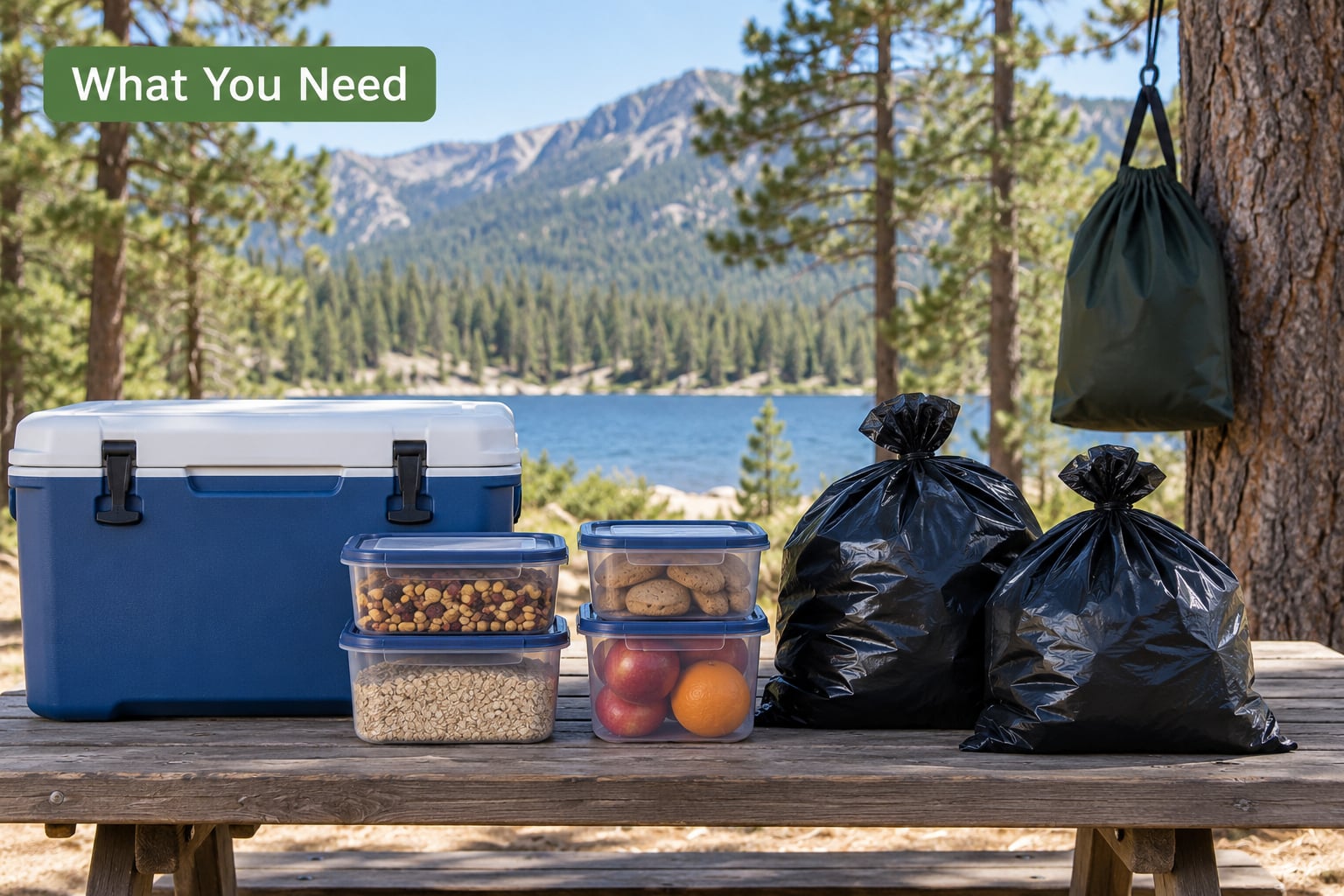
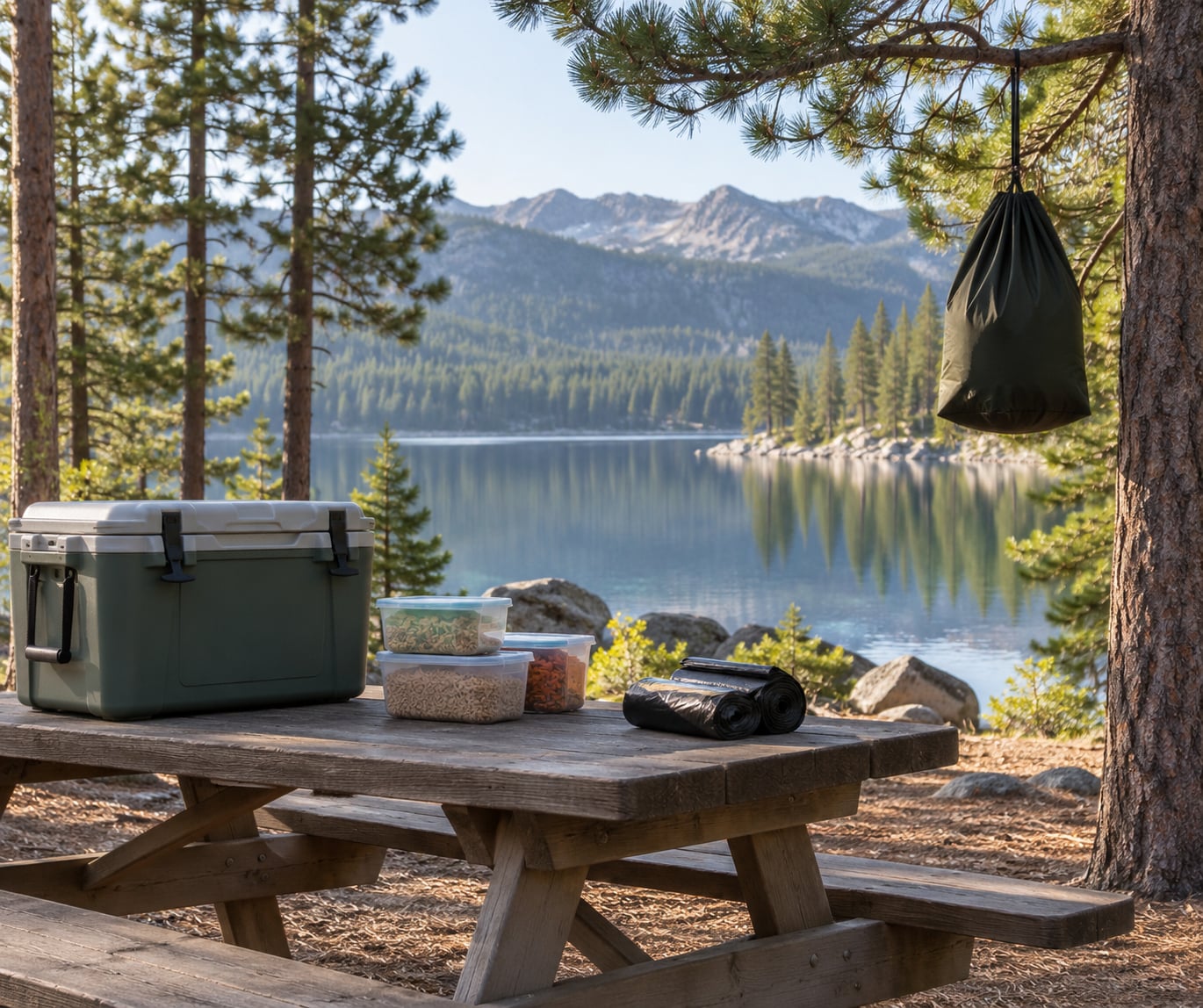
A reliable cooler is the anchor of the whole system. Pick one that holds ice for the length of your trip with room to spare, and one you can close and latch without wrestling with it in the dark.
Around the cooler, you want a few more things:
- Food storage containers. Hard-sided, latching containers beat soft bags every time. A raccoon will tear a duffel; it will not open a rigid tub.
- A bear-resistant locker or approved hanging system. Many developed campgrounds have steel food lockers on site. In the backcountry, that means a certified bear canister, a bear bag or a proper hang.
- Heavy-duty trash bags. Ordinary kitchen bags split and scatter. Get contractor-grade ones, and bring more than you think you need.
- A camp shovel. You will use it for the bear box, for burying food waste where no container exists, and for a lot of ordinary campsite tasks.
- A portable thermometer. An inexpensive instant-read thermometer is the cheapest tool you can carry. Ambient air temperature tells you nothing about what is happening inside a cooler.
- Soap and water, plus a sponge and a scraper. Food handling and animal deterrence are the same chore.
Two optional items earn their space for most trips. Bear spray is not a substitute for storage, but it is the most effective last resort when an animal does approach camp, and carrying it in a belt holster makes it reachable without fumbling. A small gas canister or a fire starter keeps cooking fast, which gets you back inside your tent sooner.
Step-by-Step
1. Plan Your Meals Before Leaving Home
The easiest way to control odors is to not bring the strong-smelling food. Canned fish, cured meat, hard cheese, chocolate and anything with garlic or onion paste pack a scent trail that animals follow straight to your tent.
Choose meals that need minimal prep. A pot of boiling water that you can pour over a dehydrated meal produces less scent than frying burgers, and it takes three minutes instead of twenty.
Pre-portion ingredients into containers you will not have to open more than once. Sort food into two groups: what needs refrigeration or ice, and what does not. That separation is what keeps your cooler efficient and your trash lighter.
How you do this part at home sets everything else up. A cooler packed haphazardly loses its cold in half the time, and a camp that smells like lunch at nine in the morning is a camp that gets visited at nine at night.
2. Keep Everything Cold in a Properly Packed Cooler
Pre-chill your cooler at home by putting a bag of ice in it for a few hours, and pre-chill your food the same way. Cold food going into a cold cooler means less energy spent on both.
Pack frozen items on the bottom and sides, where they act as cold mass, with drinks and less perishable food on top. Fill every gap. Air moving around inside a half-empty cooler warms it fast.
Keep perishable food at 40°F or below. Above 40°F, you are on a clock: eat it or throw it out within two hours, or within one hour once the air temperature is above 90°F. That is the USDA rule, and it holds in camp exactly as it does at home.
Open the cooler as little as possible. Gather what you need for one meal, take it out, and put the rest back. Opening it for a single bottle of water costs you more cold than you think.
3. Store Food and Trash in the Right Location
When the campground has a metal food locker, use it every single time, for everything: food, trash, coolers, toiletries, cleaning supplies and pet food. Lockers work because they are heavy, bolted down and not worth breaking into for a sandwich.
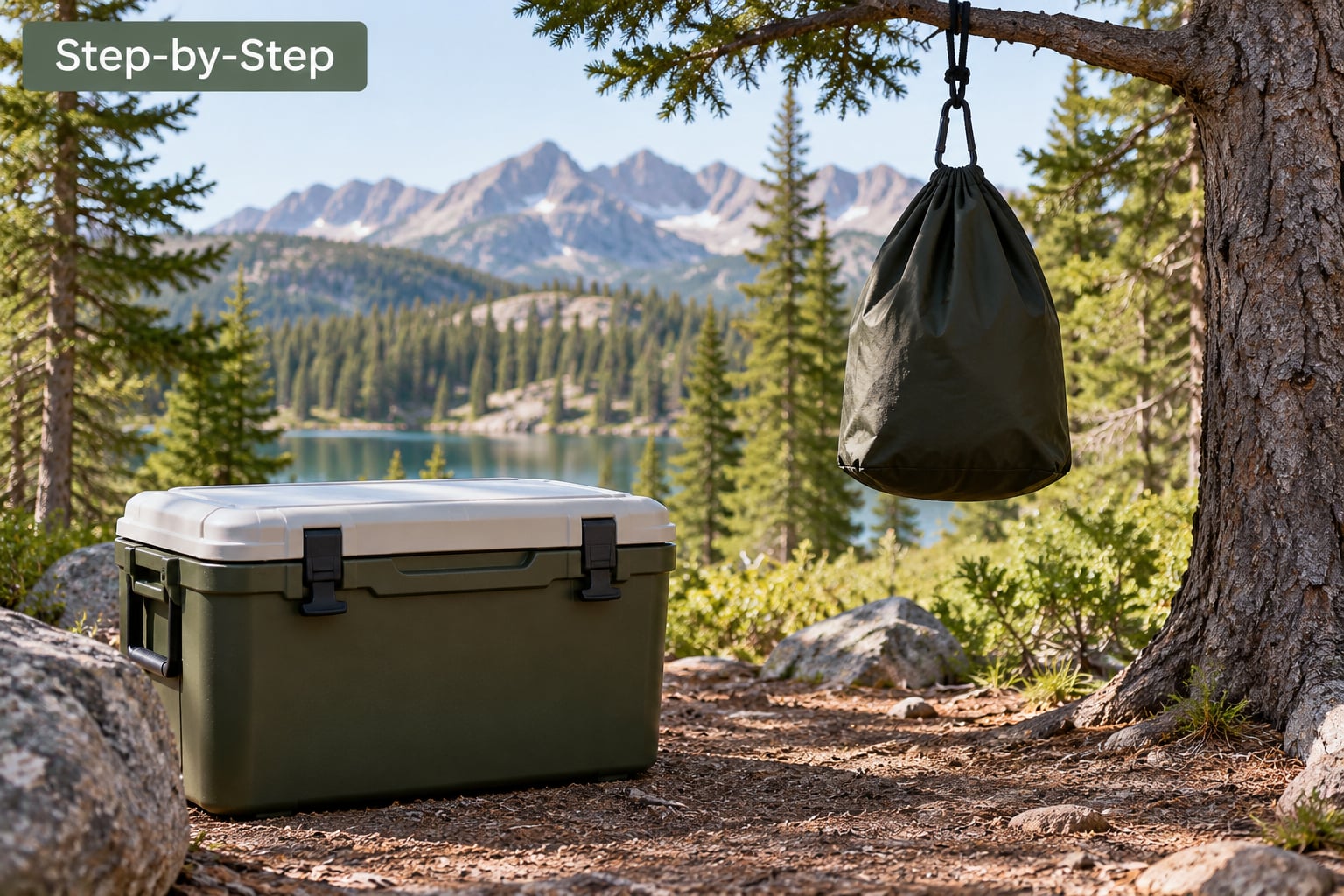
In the backcountry, use an approved method rather than improvising. A certified bear canister is the strongest choice and the most widely accepted by parks. Bear bags and hard-sided bear-resistant pouches are lighter and often approved, though some backcountry areas restrict them.
A hang is the fallback where no locker or approved container exists. The standard is 10 feet off the ground, more than 10 feet from the trunk, and 6 feet from anything else that could hold food. Build it so you cannot get back up there without a ladder, because a hang you can reach without effort is a hang a determined bear can reach too.
Check the specific rules for the ground you are on before you go. Rules change, and a method that is fine in one drainage can be illegal a hundred miles away. When a campground rule and a national park rule disagree with each other, the campground staff and the ranger station are the ones to call. Local knowledge beats anything you read online, including this.
Never store food in the car. Vehicles are not bear-proof storage, and a bear that learns to break windows will take your whole trip plus your window.
4. Prepare and Cook Food Without Attracting Animals
Set up a stable cooking surface away from your tent and your food storage, and keep it there for every meal. The widely used guideline is to cook and store food at least 200 feet from where you sleep.
The reasoning is straightforward. A tent that smells like bacon at midnight is a scent beacon, and it pulls animals into the space where you are least able to respond. Cook, eat, clean, and put the food away, then go back to the tent.
Keep food sealed until the moment you need it. Open the bag, use it, seal it again. Loose packaging sitting open on a picnic table is an invitation.
Watch grease. Bacon fat on a rock keeps its smell for days and pulls in animals long after you have left. Wipe the surface after cooking, and pack out the wipe or bag it for disposal.
Cook to a safe internal temperature every time, no exceptions. Poultry reaches 165°F, ground meat 160°F, and whole cuts of meat and fish 145°F. A travel thermometer takes seconds and removes all guessing.
5. Eat, Clean Up, and Store Leftovers Immediately
Eat at the designated table, not on the ground and not at the tent. When the meal is done, scrape every scrap into the trash. Wipe the table and the cooking surface.
Leftovers get stored the same way as the original food, not left out to “finish tomorrow.” If it has been sitting unrefrigerated longer than two hours in warm weather, toss it. Scraps in the trash still carry odor, so double-bag them and get them into an approved container before bed.
Wash your hands with soap and water before and after handling food. That step protects you from the contamination side of the problem, which is a different and less discussed risk than wildlife.
Store everything in its approved location before you settle in for the night. The single most common sequence that causes trouble is dinner, then bed, then remembering at midnight that the trash is still by the cooler.
6. Know What to Do If an Animal Approaches
Stay calm and stay put. Do not feed it, do not approach it, and do not run. Most animals are curious and will leave once they learn that people and food do not go together.
Move any food and cooler toward the vehicle, a locker or the tent where you can stand over it. Get children and pets away and keep them inside. Group campers should stay together, because animals have learned that a person alone is a person to approach.
Make yourself bigger and louder. Most backcountry guidance and park staff say the same thing: do not give an animal a calm reaction or a still target.
If the animal persists or gets aggressive, use bear spray according to its label, and get behind a solid barrier. When a situation becomes genuinely dangerous, break camp, get to a vehicle or staffed area, and contact park staff or local authorities.
Never try to recover food from an animal you cannot identify, and never corner one. Once a bear associates people with a food reward, that behavior usually ends with the animal being killed.
Common Mistakes
Most camping food losses trace back to a handful of habits that are easy to fix once you know them.
Storing food in the car. Cars leak scent through the weather seals, and bears have learned to break them. Correction: use the campground locker, and keep the car for sleeping and gear, not for snacks.
Leaving pet food outside. Dog food smells and it is often the easiest target in camp. Correction: pet food, bowls and treats go in the locker with everything else.
Storing scented items next to food. Toothpaste, deodorant, sunscreen, insect repellent and cleaning supplies all attract. Correction: everything that smells goes in the same secure spot as the food, or nothing is secure.
Relying on plastic bags. Ziploc bags and grocery bags are not storage in wildlife country. Raccoons and rodents get into them easily. Correction: hard-sided latching containers, and only soft bags rated for bear resistance.
Cooking at dusk and lingering. Evening cooking means people, food and scent all overlap in the dark right before you go to sleep. Correction: cook earlier when you can still see what you are doing, and clean up in daylight.
Leaving grease, dishwater and loose trash. A rinsed pan is an invitation that lasts for days. Correction: wash with soap and hot water, pack out dirty water where required, and bury or containerize food waste where no container exists.
Frequently Asked Questions
What is the 200 rule for camping?
The 200 rule means cooking, eating and storing your food at least 200 feet away from where you sleep. It reduces the chance that scented gear draws an animal to your tent at night. Many parks and campgrounds ask for this in backcountry and dispersed sites. Pick a cooking spot before it gets dark, keep it consistent for the whole trip, and clear it out completely after every meal.
Can bears smell through ziploc bags?
Yes, treat a ziploc bag as no protection at all. Bears and raccoons can find food through thin plastic, and rodents chew straight through it. Use rigid latching containers or an approved bear-resistant bag or canister instead. Vacuum-sealing helps slow the smell from escaping in a normal pack, but it is not wildlife-proof storage on its own and does not replace an approved method.
What keeps animals away when camping?
Four things do most of the work: put all food, trash and scented items in a bear-resistant locker, canister or proper hang; keep your tent and sleeping area free of food odors; clean the cooking surface and remove every scrap after each meal; and never feed or approach wildlife. Cooking 200 feet from camp adds meaningful protection. Bear spray is a last resort, not a substitute for storage.
What do you put your food in while camping with bears around?
Use whatever the local rules require, in this order of strength: a metal bear-resistant locker at a developed campground, a certified bear canister in the backcountry, or an approved bear-resistant bag or pouch where those are permitted. A properly built hang is the fallback when nothing else is available or allowed. Check the specific park or forest rules before you leave home, since bag and hang approvals vary by area.
Where should I store food in a car camp?
Use the campground’s bear-resistant locker, and put food, coolers, trash, toiletries and pet food inside it every time, including while you are at the picnic table. If no locker exists, a heavy-duty bear-resistant cooler is the next best option. Do not keep snacks or leftovers in the vehicle overnight, because vehicles are not wildlife-proof and the smell escapes through the seals.
What do I do if an animal gets into my food?
Give the animal space, do not approach it and do not try to take anything back while it is there. Once it leaves, clean up every remaining scrap, remove grease from surfaces, and reset your storage method before you go to sleep. Bag and carry out the ruined food so nothing attracts another animal overnight. Tell park staff or a ranger, because repeat incidents usually mean a storage problem rather than bad luck.
Start With the Storage Decision
If you do one thing before you pack the car, decide which storage method your specific campground or backcountry route requires, and get that gear. Everything else here is maintenance around that one choice.
Then pack the cooler tight and cold, cook away from camp, and clear the table after every meal. Food that stays cold and stays sealed is food nobody else gets to eat.