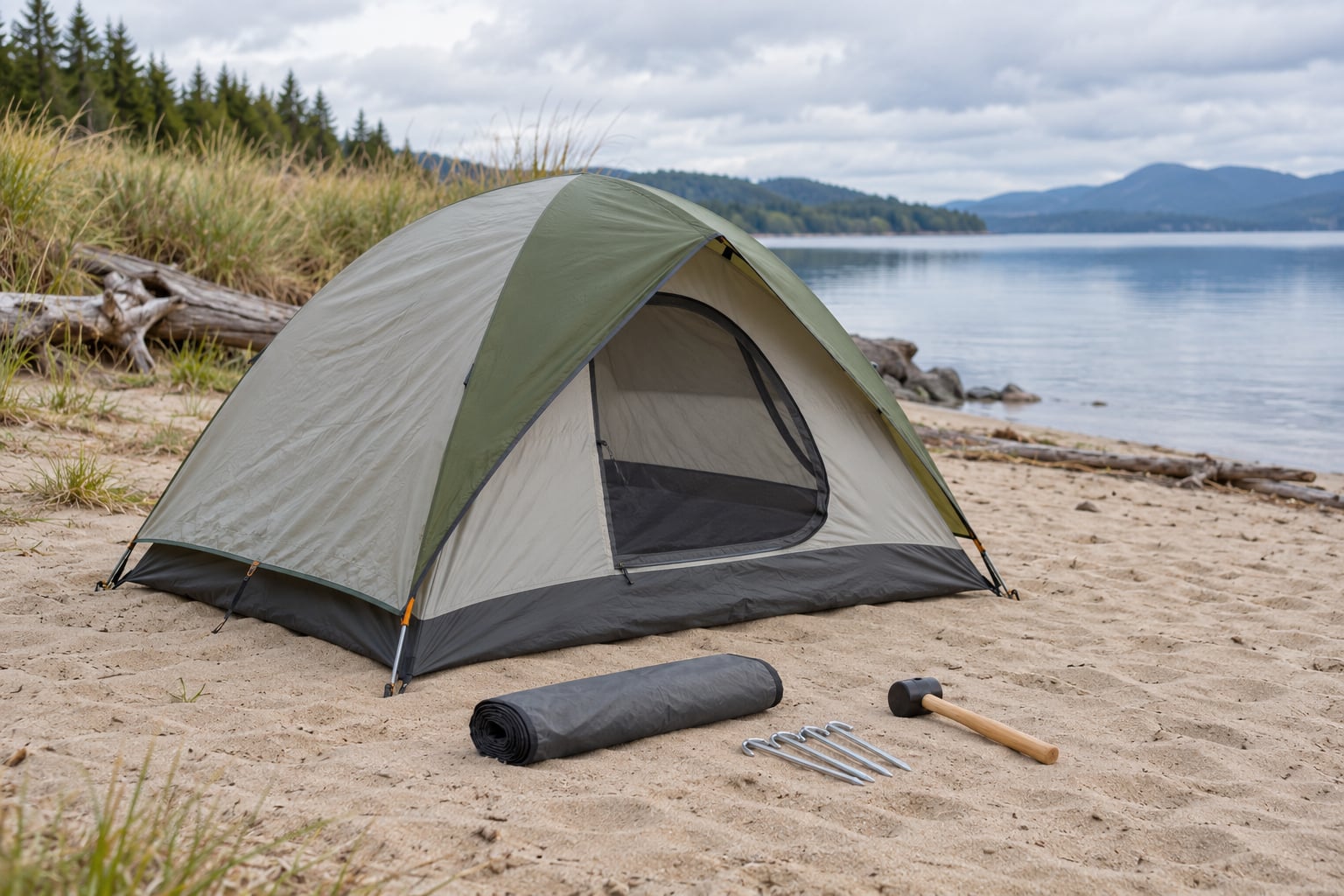
If you have never worked out how to set up a tent on sand or soft ground, the fix is preparation and anchor choice, not muscle. Pick the highest, firmest patch you can find, lay down a footprint so the floor does not sit in damp or abrasion, and anchor with something that grips or buries instead of the short stake most tents ship with. Sand has almost no holding power, so a factory stake usually pulls straight out in a gust.
The full process takes about 15 minutes once you know it, and it runs from picking the site through to testing the pitch before dark.
Table of Contents
- 1What You Need
- 2Step-by-Step: How to Set Up a Tent on Sand or Soft Ground
- 31. Choose a Stable, Well-Drained Site
- 42. Check the Forecast and Ground Conditions
- 53. Protect the Tent Floor
- 64. Assemble the Tent Away From the Finished Pitch
- 75. Mark the Footprint and Position the Tent
- 86. Insert the Tent and Raise the Frame
- 97. Anchor and Test the Tent
- 10Common Mistakes
- 11Frequently Asked Questions
- 12What are the best tent anchors for sand?
- 13How deep should tent stakes go in sand?
- 14Do you need a ground sheet or footprint on sand?
- 15What do I do when the ground is wet or very soft?
- 16How much slope can a tent handle?
- 17Conclusion
What You Need
Gather this before you unpack anything. On soft ground you want everything within arm’s reach, because you will move the tent at least once after the first pitch.
- Your tent plus its full kit — body, poles, rainfly, guylines, and every factory stake and stake loop. Count them before you leave the tent bag.
- A mallet or hammer for driving anchors. On soft ground a rubber mallet is often enough; on a firm patch it is useless, so bring one that suits the terrain rather than assuming.
- Extra cord — 5 mm utility cord or a short length of p-cord. Several extra 6 to 10 foot lengths give you anchors, guy lines and a repair tie without untying anything structural.
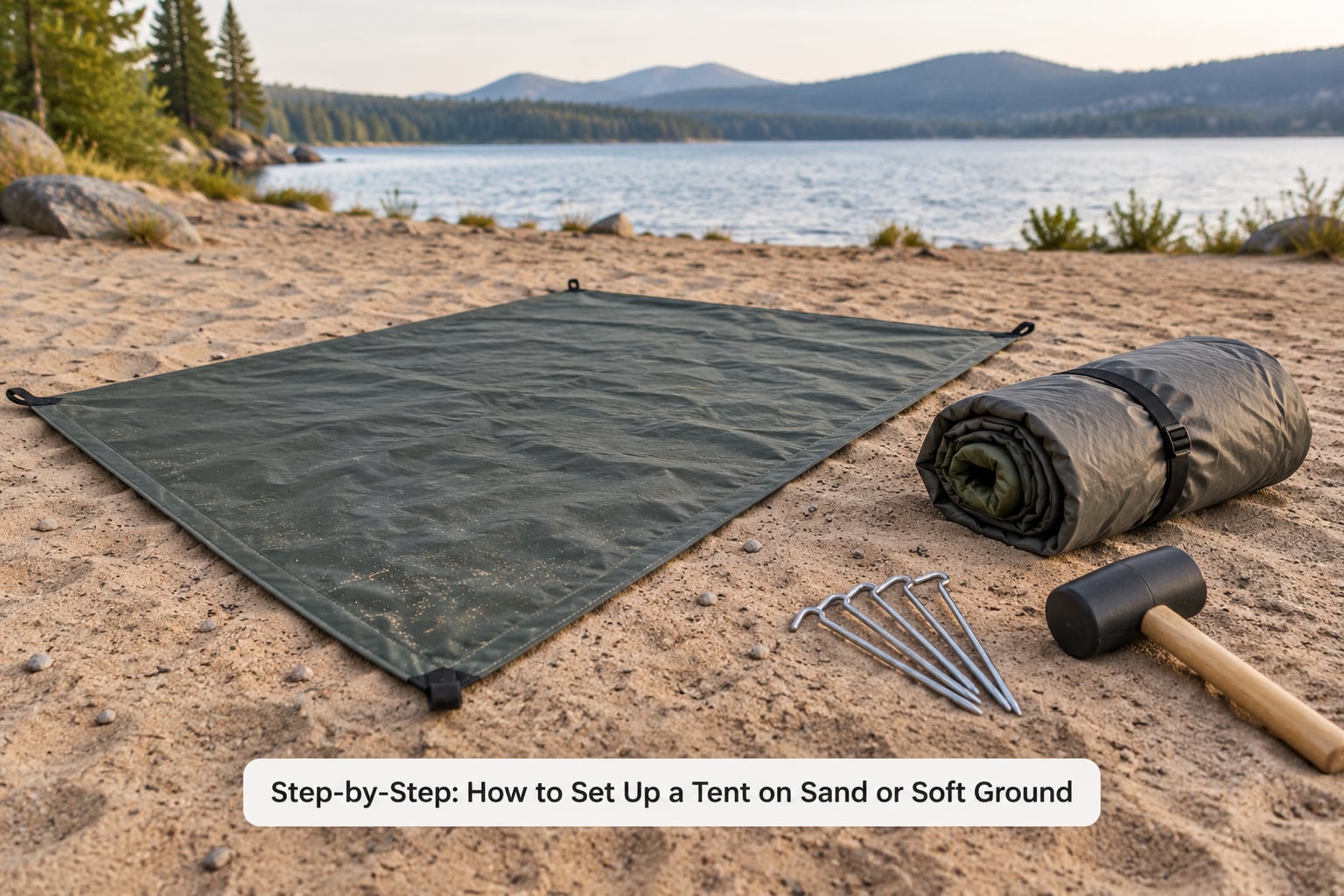
- Ground protection — a footprint sized slightly smaller than your tent floor, or a cut piece of outdoor carpet. On sand this guards against abrasion; on damp ground it guards against moisture wicking up from below.
- Anchors matched to the ground — see the anchor breakdown in step 7 for which type suits sand, wet mud, firm gravel and soft snow.
- A tarp or groundsheet if rain is possible, to keep bedding and gear dry while you work.
- Optional but useful — a stake puller, duct tape, a patch kit, filled sand bags for weighting corners, and a couple of rocks or a piece of driftwood for anchoring.
- Safety basics — a headlamp for late-night anchoring, water, and the local rules for the shoreline or state park you are camping in.
Step-by-Step: How to Set Up a Tent on Sand or Soft Ground
1. Choose a Stable, Well-Drained Site
Walk your patch before you commit to it. You want ground that is slightly raised, firm underfoot, and free of roots, rocks, standing water and thick vegetation. Flat matters more than convenient — a level pitch beats a sheltered one that drains into a puddle.
Two tests help. Press a heel firmly into the ground: if it sinks deep and stays compressed, that spot will compress your sleeping pads and let poles settle overnight. Then look for a place where water would run past your tent rather than through it. Signs you should move: a wash channel, dark saturated soil, dead grass mats, existing footprints from earlier campers, or a patch of loose fill that looks recently dumped.
2. Check the Forecast and Ground Conditions
Wind direction decides orientation, and recent rain decides where the firm ground is. Sand that was firm last month may be soft and deep now, and wet sand holds a driven stake better than dry sand even though it feels worse underfoot.
Note the strongest expected wind direction and aim the tent’s weakest face — usually a broad end panel — into it. Prefer a sheltered but well-drained spot over a low, still, convenient one. A site behind a dune or near a treeline is often dramatically safer than the exposed, windier pitch 30 feet away, and it tends to be quieter too.
3. Protect the Tent Floor
Lay your footprint or groundsheet down first, slightly smaller than the tent floor so rain runs off it instead of funneling back under the walls. On sand this stops grit working at the seams and stops damp rising through the floor fabric.
Watch for one trap: a plastic sheet over wet, soft ground can trap water and make things worse, so only lay one on ground that is already drained. Where the surface is very soft, a tarp, a folded sleeping pad under the low corner, or a cut piece of outdoor carpet gives the floor a stable base to sit on.
4. Assemble the Tent Away From the Finished Pitch
Build the tent where you have room to work, ideally on firm ground off to one side, then carry it into position. Shock-corded poles tangle fast on sand, and a partly raised tent dragged across loose ground deforms the frame.
Check the body, poles, stakes, guylines and rainfly while it is still flat and readable. Fit the poles into their sleeves or clips, locate every guy line and its attachment point, and confirm the rainfly matches the body. Reading the manufacturer’s instructions here saves a lot of fumbling once the frame is up and the wind picks up.
5. Mark the Footprint and Position the Tent
Outline the tent with small rocks, sticks or shallow scrape marks so the pitch is repeatable. Then set the tent down, check the entrance faces away from the prevailing wind, and leave yourself enough room to walk around and reach every corner with a mallet.
On a slope, orient so the higher side is the sleeping side. It keeps condensation and drips off your head, and it means your gear can sit on the uphill edge where it will not slide.
6. Insert the Tent and Raise the Frame
Clip the inner tent to the poles, starting at the two ends, then bring the middle section up. Push the feet of the poles into soft ground a little deeper than on hardpan — a pole that sits on the surface gains leverage against shifting sand, and it can change the pitch geometry as the ground settles.
Once the frame stands, check that seams and panels sit square and that nothing is twisted. Fit the rainfly and tension it evenly; a taut fly sheds water and wind load, while a slack one flaps and channels gusts into the body of the tent.
7. Anchor and Test the Tent
Follow the manufacturer’s recommended angle for each stake, which is usually leaning away from the tent so the load pulls down into the ground rather than up and out. On sand, angle matters less than depth and burial. Adjust guylines until the fly is taut without being wire-strung, then test the pitch: push each corner hard and watch for movement.
Not every anchor behaves the same way in sand, and picking the wrong one is the single most common reason a beach pitch fails:
- Buried dead-man anchor — excellent in sand. Best for deep loose sand and soft soil. Bury a piece of wood or pipe 12 to 18 inches with cord tied around the middle, so pull-out force slides the soil past the anchor instead of lifting it.
- Sand spike or sandhog-style anchor — excellent in sand. A purpose-built wide profile for sand, light soil and some snow. Drive it flush with the ground, which takes a few firm blows.
- Buried horizontal stake — very good in sand. Dig a trench, lay the stake flat about a foot down and backfill. It rarely pulls up, and it is the easiest anchor to make from scrap.
- Cut fiberglass pole section — good in sand. Two-foot sections of a discarded pole with the shock cord removed. Light, reusable and surprisingly strong in loose soil.
- Buried PVC pipe or a filled sand bag — good in sand. Low cost and easy to make on site. A sand bag full of local sand works well on pop-up tents and beach pitches.
- Standard tent stake, driven deeply — poor in sand. Fine on firm soil and hardpan, but it pulls out in a gust on loose sand no matter how hard you hit it.
- Rock or driftwood tie-off — fair. Reliable on rocky desert ground and shingle beaches, useless on flat featureless sand.
If you bury anchors, mark where you put them and dig them up before you leave. Nothing kills more goodwill at a popular beach site than a canopy frame and six dead-men still buried under the sand.
Common Mistakes
- Using short standard stakes in deep sand. A stake that bites a few inches has almost nothing to hold. Correction: use a buried dead-man, a purpose-built sand anchor, or a horizontal buried stake. Tip: if you can only find cord and scrap wood, bury them rather than drive them.
- Ignoring slope. A tilted pitch dumps water and gear toward the low side. Correction: pick a level patch if one exists; if not, sleep on the uphill side, add guylines on the low side to lift the sag, and stash gear on the high edge.
- Pitching in a washout or swale. That depression fills first in rain. Correction: look for the path water would take and pitch beside it, not in it.
- Skipping floor protection. Sand finds every seam and damp rises through bare floor fabric. Correction: footprint or groundsheet, cut slightly smaller than the floor, laid only on drained ground.
- Guylines pulled too tight. Over-tensioning fabric bows poles and strips seams. Correction: snug, not guitar-string, and re-check after a few hours as the ground settles.
- Pitching a tarp or non-freestanding shelter on soft ground. There are no corners to stake, so the whole load transfers to the guy lines. Correction: bury dead-men for every guy line and treat tension as a continuous adjustment rather than a single pull.
- Forgetting wind load on the fabric. In extreme gusts an erected frame can act as a sail. Correction: know your bail-out before dark, and in severe conditions collapse the poles rather than fight the wind.
- Pitching too close to the water. Shoreline sites carry setback rules and fragile dune grass. Correction: check the local regulations and the tide table, and camp above the high-water line with the tent well back from the edge.
Frequently Asked Questions
What are the best tent anchors for sand?
Buried dead-man anchors are the most reliable option in loose sand. Bury a piece of wood or pipe 12 to 18 inches deep with cord tied around the middle, so the pull-out force slides the soil past the anchor instead of lifting it. Purpose-built sand spikes and sandhog-style anchors are the best buy-to-carry choice. Standard stakes, buried horizontally, or rocks tied to guylines all work as field alternatives.
How deep should tent stakes go in sand?
Drive or bury deeper than feels comfortable. For dead-man anchors, 12 to 18 inches is the range most campers report working well on dunes and soft soil. Driven stakes need enough depth that the surrounding sand cannot collapse around the shaft, which is why the same depth that works on firm ground fails on loose sand. Leave the head end flush so nothing catches a foot.
Do you need a ground sheet or footprint on sand?
Yes, a footprint or groundsheet is worth carrying even though sand looks dry. It stops grit working at the floor seams, reduces abrasion, and keeps damp from wicking up through the floor. Size it slightly smaller than your tent floor so water runs off the edges instead of funneling back underneath. On already-wet, poorly drained ground, skip the sheet or use a breathable groundsheet.
What do I do when the ground is wet or very soft?
Move to the highest, driest ground you can find and lay something firm under the tent floor, such as a tarp, folded sleeping pads, or a cut piece of outdoor carpet. Wet sand grips better than dry sand, so anchors bite more easily, but deep mud and peat give way under a loaded tent. Expect the pitch to settle overnight and re-check guy line tension before sleeping.
How much slope can a tent handle?
Most dome tents handle a few degrees of tilt comfortably, and a freestanding frame tolerates more because it can stand before you stake it. On a noticeable slope, orient the tent with the high side where you sleep, tighten guylines on the low side to lift sagging fabric, and put your gear on the uphill edge. On sand, move to flatter ground if you can rather than working around the slope.
Conclusion
If you do one thing before you start, walk the site and find the highest, firmest, best-drained patch you can get, because that decision solves more problems than any anchor. Lay a footprint on that ground, raise the frame, and anchor with buried dead-men or a purpose-built sand anchor rather than short stakes driven by hand. Adjust for the ground you actually have — deeper burial in loose sand, extra guylines on a slope — and then push each corner to confirm the pitch holds.