To stay cool camping in summer heat, do three things: pitch the tent in shade with airflow on both sides, keep it ventilated rather than sealed, and drink on a schedule instead of waiting for thirst. Add a tarp overhead, move strenuous hours to the morning, and put your sleeping pad off the hot ground.
The mistake most people make is treating heat as gear problem. A single battery fan will not save you on a 95 degree afternoon if the tent is sitting in full sun with the fly zipped shut. What works is the setup around the tent, built before the worst part of the day arrives.
Our family camps in the Southeast every July, where humidity regularly sits above 70 percent and shade is the scarcest thing at any campground. These are the routines that came out of those trips, not theory.
Table of Contents
- 1What You Need
- 2How to Stay Cool Camping in Summer Heat: Step-by-Step
- 3Check the forecast and choose a cooler campsite
- 4Set up the tent for maximum airflow
- 5Create shade around the living area
- 6Hydrate before you feel thirsty
- 7Change the timing of hot activities
- 8Use wet cooling and light clothing
- 9Keep meals and equipment cooler
- 10Common Mistakes
- 11Frequently Asked Questions
- 12What temperature is too hot for camping?
- 13How do you keep a tent cool without electricity?
- 14How do you stay cool camping in 90 degree weather?
- 15How much water should I drink a day when camping in the heat?
- 16What are the warning signs of heat exhaustion while camping?
- 17Can you cool a tent with electricity at a campsite?
- 18Conclusion
What You Need
None of this is expensive or exotic. Pack it the night before and the campsite work takes about ten minutes.
- Shade sources: a four-by-four tarp with guylines, a beach umbrella, or a lightweight canopy. Trees and a parked vehicle count too.
- A reflective surface: an aluminized tarp, a space blanket, or a reflective windshield cover. Silver sides face the sun, dark sides face the ground.
- Water storage: enough drinking water for every person for the whole trip, plus a two-to-three liter reserve that nobody touches. Insulated jugs hold cold longer than plastic bottles.
- Ventilation gear: a small battery or USB fan, six-foot or so, and a handful of stakes or rocks for propping panels open.
- Cooling supplies: a spray bottle, two or three microfiber or cooling towels, and a few clothespins.
- Weather information: a forecast you actually check 48 hours out, and the heat index rather than the bare air temperature.
- Light clothing: loose, pale, long-sleeved moisture-wicking shirts, wide-brim hat, sunglasses, and shoes that can be soaked.
- Sleep setup: a cot or a pad with a higher R-value than the ground requires, plus a cotton sheet or sleeping bag liner.
- First aid coolers: chemical cold packs for neck, armpits and groin, kept in the shade.
How to Stay Cool Camping in Summer Heat: Step-by-Step
Check the forecast and choose a cooler campsite
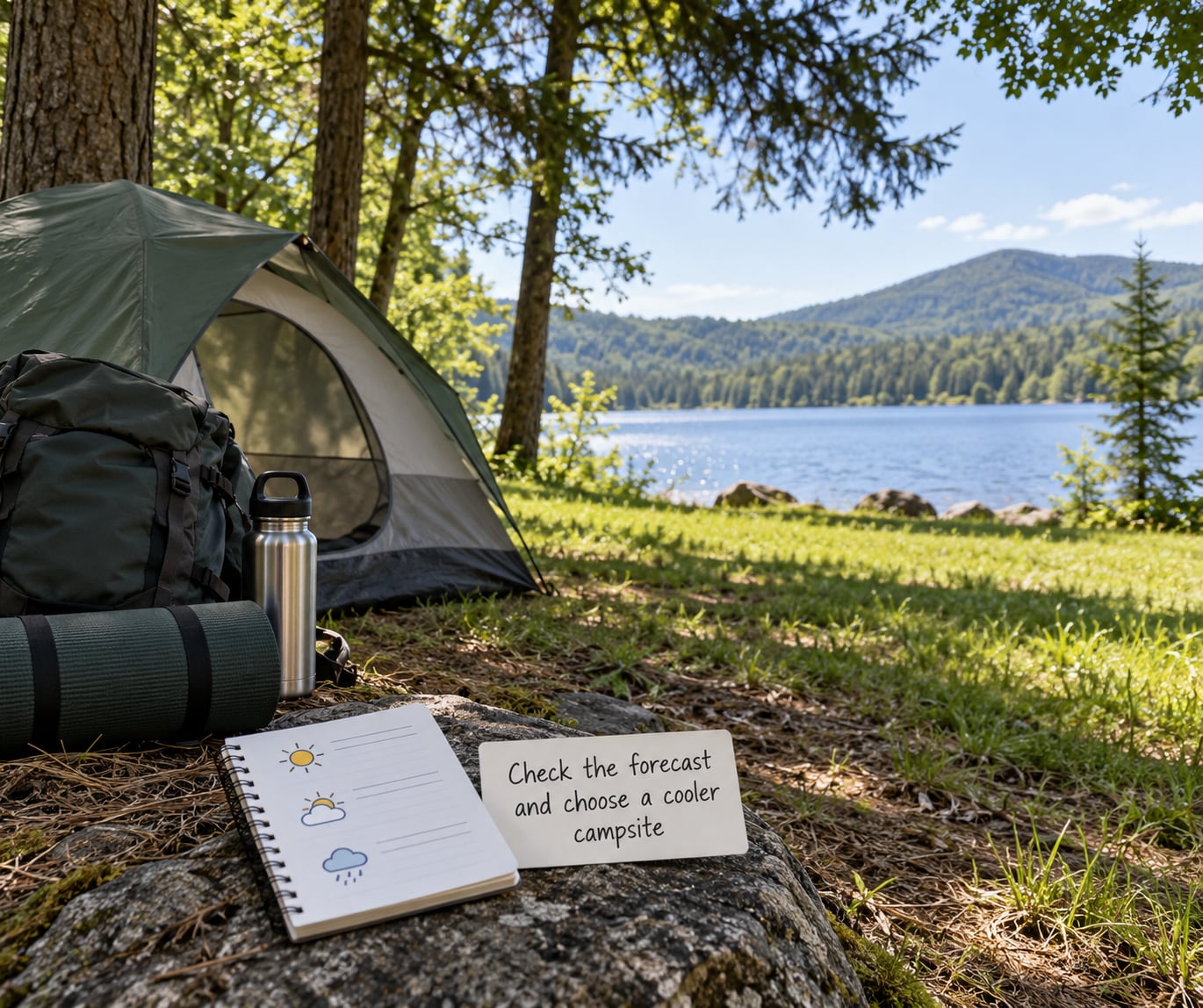
Check the forecast 48 hours before you leave and read the heat index, not the number with a degree sign. Humidity is what turns a 92 degree afternoon into a genuinely dangerous one, because your sweat cannot evaporate.
At the campground, walk the site before you unpack. You want canopy overhead, ground that is shaded in the afternoon, and airflow, which usually means open grass, a lakeside edge, or the top of a slope rather than a hollow between two ridges.
Skip bare rock, sand pads and asphalt, which radiate heat straight into the tent all evening. Campers on Reddit describing 90-plus trips keep repeating the same advice: the shady pitch behind the loop was empty every time, because most people walk straight to the waterfront site and bake.
Also check wildfire restrictions and thunderstorm risk before you go, and know the nearest town so an early exit is a decision rather than a scramble.
Set up the tent for maximum airflow
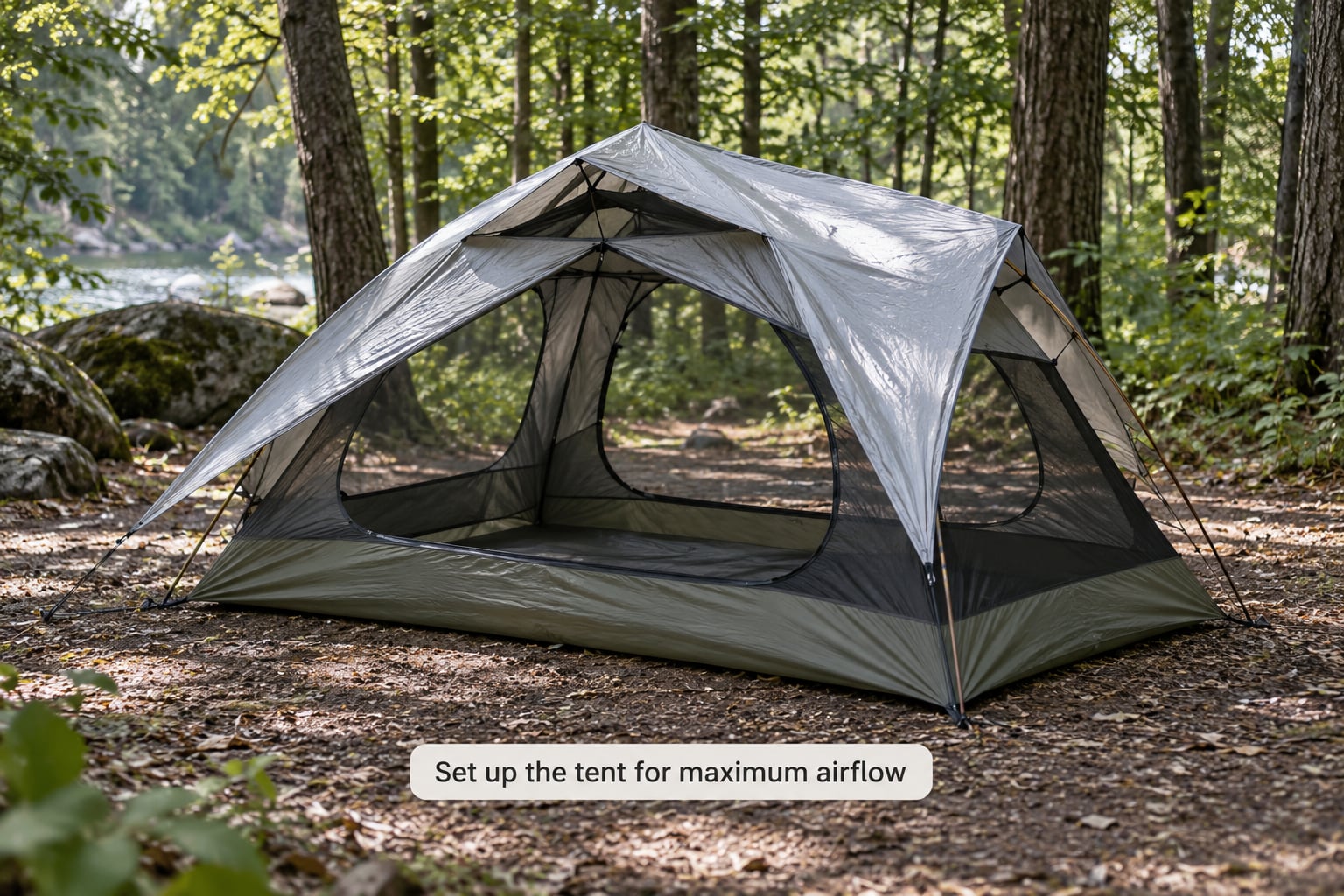
Airflow beats insulation in summer. Pitch with the door and windows facing whatever breeze you can find, and stake the fabric panels out away from your body rather than tucked tight against the poles.
Prop every vent and window open. Most tents have roof vents that are useless unless the fly is also lifted, so tent the fly about a hand’s width above the tent at the top. The gap lets hot air escape through the chimney effect while shade still falls below.
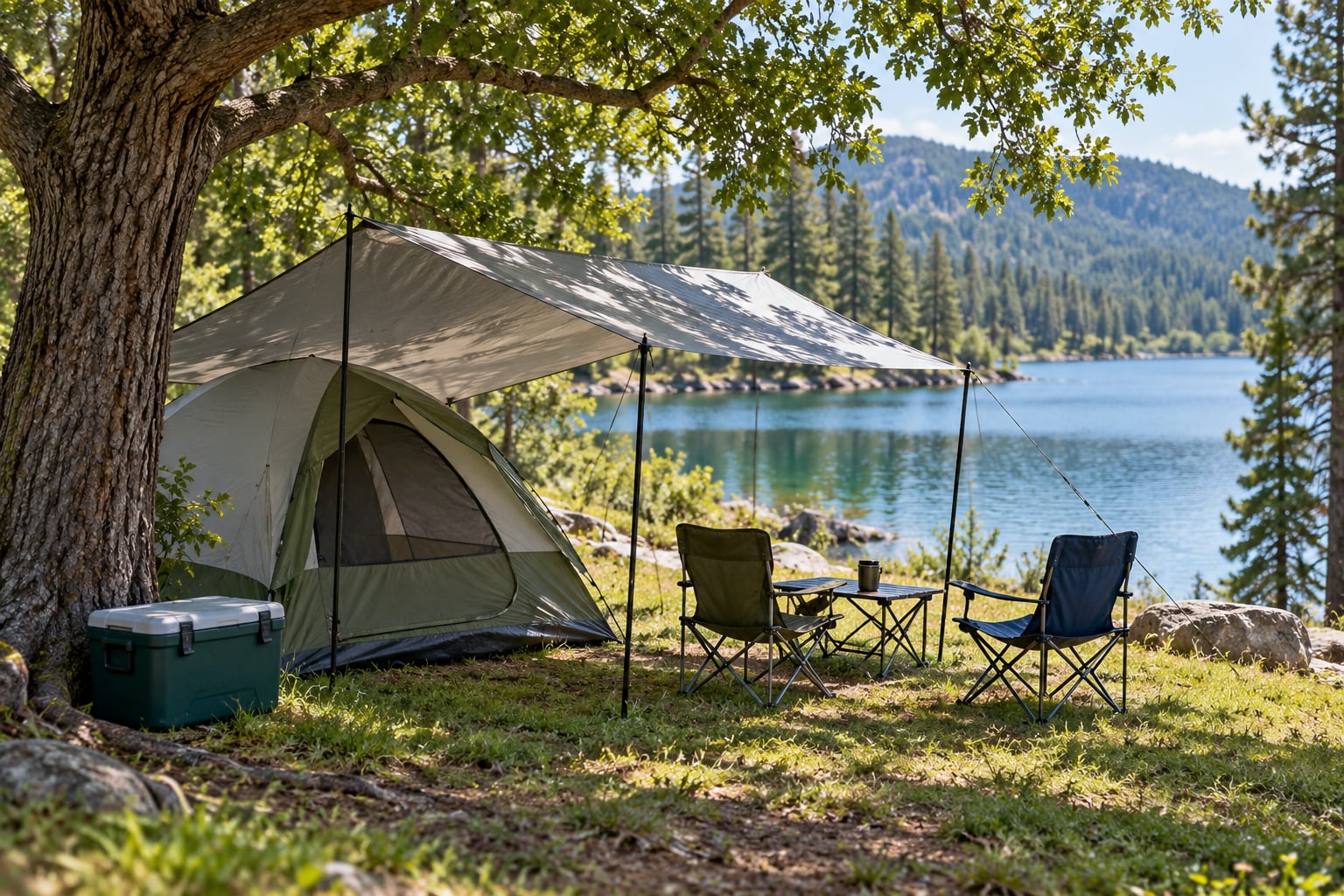
Hang the tarp high above the tent with air between it and the fly, roughly 30 cm or more. Touching fabric transfers heat straight down, so the gap is the whole trick. Aim the reflective side at the sun and pitch before noon if you can.
On clear nights with no lightning forecast, pull the fly off entirely and let the tent radiate heat to the sky. Do this only after the sun is well down; the greenhouse effect runs the other direction at night.
You will know the setup worked by the time you crawl in at bedtime. If the tent is warmer inside than outside at sunset, the site is wrong and moving camp beats fighting the tent.
Create shade around the living area
Shade over the table matters as much as shade over the tent. Tarps, canopies, umbrellas and the vehicle itself all work, and campers regularly park a truck so its body blocks the afternoon sun off the tent door.
Keep shade structures high enough that you can sit or stand underneath without pressing your head into the fabric. Direct sun on a tarp heats the air under it noticeably, so airflow under the canopy is part of the setup.
For the tent itself, shade from a tree or the vehicle body usually beats a tarp because it moves with the sun. If your tarp only shades the tent at 10 a.m., it will be sitting in full sun by 3 p.m., which is exactly when you need it.
Hydrate before you feel thirsty
Thirst trails dehydration by a good margin, so drinking only when you feel dry already means you are behind. Start before the campsite is packed and keep a bottle in your hand rather than in the cooler you walked away from.
A workable baseline for an adult is roughly 2 to 3 liters of fluid across the day in ordinary conditions. In real summer heat with any activity, most campers need 3 to 4 liters, and the low end for a heavier person or a hard hike on a 95 degree day.
Take small sips every 15 to 20 minutes rather than a liter at once. Add electrolytes or a pinch of salt to at least part of that volume, especially if you are sweating hard, since water alone flushes sodium out over a long day.
Eat foods with water in them: cucumbers, tomatoes, oranges, watermelon, berries. Keep an insulated jug in the shade and refill it overnight from a stream or tap so it is cold in the morning.
Watch pale urine as your gauge. Dark amber means drink now, and clear straw-colored is the target.
Change the timing of hot activities
The same hike is pleasant at 7 a.m. and unpleasant at noon. Move the strenuous stuff into early morning and evening, and treat roughly 11 a.m. to 4 p.m. as recovery time.
Fishing and paddling suit the early and late windows, since boat decks and lake surfaces reflect glare straight into you at midday. For an afternoon walk, keep it to shade and a short loop, and turn back at the first tired feeling.
Meals work better in the cool hours too. Cook early or late and the stove heat is out of your life during the worst stretch. If you want a campfire, have it after sunset, and skip it entirely on nights when the air stays above 70 F.
Use wet cooling and light clothing
Wet cooling works because evaporation takes heat off your skin, and it fails in high humidity. In dry heat a damp towel or a misted fan cools you noticeably. In muggy air the same tricks barely do anything, so lean harder on shade, airflow and water there.
Soak a towel in cold water and drape it over your neck and shoulders, or twist a spray bottle with a few drops of dish soap in it, which cools a little better than plain water. Wet bandanas and cooling towels work the same way and cost nothing to bring.
Wear loose, pale, long sleeves in moisture-wicking fabric. Covered skin stays cooler than bare skin in full sun, and a wide-brim hat cuts more solar load than most people expect.
Hit the lake before dinner when you have safe access. A ten minute swim or a wading dip drops core temperature more than any gadget, and it is the reason lakeside sites beat inland ones in summer.
Keep meals and equipment cooler
Pre-chill what you can. Freeze water bottles and juice containers overnight and use them as cooler ice; they add liquid to your drinking supply as they melt instead of waterlogging the food.
Keep the cooler shut. Every open lid lets in warm air, and a closed cooler in shade holds its temperature far longer than the same cooler in sun. Store it under the tarp with the lid down, and pack food in already cold rather than warm.
- Raw meat belongs in its own sealed container at the bottom of the cooler, kept at 40 F or below, with a separate bag above it for ready-to-eat food.
- Poultry reaches 165 F, ground meat 160 F, and whole cuts or fish 145 F when you cook them.
- Perishables that will not stay cold within two hours in 90 F heat, or one hour above 100 F, need to be cooked, iced or dropped.
Keep hot gear out of the shade area, not in it. A camp stove or a generator parked beside your cooler will undo the whole arrangement.
Common Mistakes
Pitching in full sun because the site was convenient. This is the one that ruins trips. Walk past it and take the shaded pitch, even if it means carrying gear farther.
Closing the tent during the day. People zip up to hide gear or keep bugs out, then climb into a sealed hot box at 5 p.m. Leave vents propped and the fly loose.
Relying on cold drinks alone. A chilled beverage feels good and does very little for core temperature. Shade, airflow and wet cooling do the work.
Staying active through peak heat. Fishing hard or hiking at 2 p.m. in a headwind is how heat exhaustion starts. Idle time is the correct strategy.
Leaving kids or dogs in a parked vehicle. A closed vehicle heats up dangerously fast even on a mild day, and pets and young children overheat far quicker than adults. Take them with you, every time.
Setting up camp in a low spot. Cold air and heat both drain into hollows. Camp on the slope where air keeps moving.
Frequently Asked Questions
What temperature is too hot for camping?
There is no single cut-off, because humidity matters as much as air temperature. As a practical guide, a daytime high near 90 F with moderate humidity is manageable with shade and airflow, while 95 to 100 F pushes most campers into a real caution zone. Above 100 F, or whenever the heat index reaches about 105 F, serious heat illness becomes likely within hours. In muggy conditions with little overnight cooling, move to a shorter trip or a place with air conditioning.
How do you keep a tent cool without electricity?
Open every vent and window, lift the rainfly so air moves under it, and stake panels away from your body for cross-ventilation. Hang a reflective tarp high above the tent with a clear gap, and remove the fly entirely on clear nights so heat radiates away. A cot lifts you off hot ground, and a damp towel on your neck finishes the job.
How do you stay cool camping in 90 degree weather?
At 90 degrees, humidity decides how hard the day is. Pick the shadiest pitch available, keep the tarp up from arrival, and treat 11 a.m. to 4 p.m. as quiet time. Drink on a schedule of small sips every 15 to 20 minutes instead of waiting for thirst, wear loose pale sleeves, and use a lake dip in the late afternoon. Nights that stay above 70 F make sleeping the harder problem.
How much water should I drink a day when camping in the heat?
Most adults need roughly 3 to 4 liters of fluid across a hot camping day, and closer to 4 liters if you are active, heavier, or camping above 6,000 feet. Carry that amount plus a 2 to 3 liter reserve nobody plans to drink. Take small sips on a schedule, add electrolytes or a pinch of salt for heavy sweating, and use pale straw-colored urine as your guide.
What are the warning signs of heat exhaustion while camping?
Heat exhaustion usually brings heavy sweating, headache, nausea, dizziness, cool clammy skin, muscle cramps and a fast weak pulse. Move the person into shade, loosen clothing, cool with wet cloths and cold packs on the neck, armpits and groin, and give fluids if they are fully awake. If symptoms worsen, or if the skin turns hot and dry with confusion, call emergency services right away.
Can you cool a tent with electricity at a campsite?
Yes, if the site has power or you bring a portable power station. A window air conditioner unit inside the tent drops temperature well, but it needs a sealed tent and quiet continuous power. A swamp cooler built from a box fan and a wet pad uses less power and works in dry heat, though it does almost nothing in humid air. Two small fans in a cross-draft arrangement often beat one large fan on a full battery.
Conclusion
If you do five things this trip, do these: check the heat index 48 hours out, take the shadiest pitch with airflow instead of the closest one, tarp the tent with a gap and prop the vents open, keep water within arm’s reach and drink on a schedule, and move hard activity out of the 11 a.m. to 4 p.m. window.
Everything after that is refinement. Shade and timing do more for comfort than any single gadget you can pack.